
 By
Getting sales from a dropshipping store feels exciting, but sales alone do not tell you whether your business is making money. A product can generate thousands of dollars in revenue and still lose money after advertising, supplier charges, payment processing, shipping, and refunds.
A dropshipping profit calculator helps you estimate what remains from each order after the costs you enter. It can also help you understand your profit margin, maximum affordable advertising cost, and break-even return on ad spend (ROAS) before you increase your budget.
- Calculate dropshipping profit per order.
- Estimate net profit margin after advertising and payment fees.
- Calculate break-even ROAS and maximum ad cost per order.
- Understand discounts, refunds, and other costs.
- Use a free calculator to test different product scenarios.
A practical estimate of profit per order is selling price minus product cost, shipping, advertising cost, payment fees, refunds or other variable costs, and any additional expenses you include. Divide the resulting profit by the selling price and multiply by 100 to calculate the profit margin.
Dropshipping Profit Calculator
Enter your product selling price and estimated costs below. The calculator will estimate profit per order, profit margin, break-even ROAS, and the maximum advertising cost you can afford before the order becomes unprofitable under these assumptions.
This tool provides a simplified estimate, not accounting or tax advice. It assumes the entered selling price is the revenue used for the calculation. Taxes, platform fees, discounts, chargebacks, overhead, and other costs are not included unless you enter them.
What Is the Dropshipping Profit Formula?
The basic formula is straightforward: subtract the costs of fulfilling and selling an order from the revenue you receive. The challenge is remembering every cost that applies to your business.
Total costs may include the supplier's product price, shipping, payment processing, advertising, refunds, transaction fees, and other variable expenses.
For a more useful estimate, separate your costs into three groups:
- Product fulfillment: supplier cost, packaging, and shipping.
- Sales and transaction costs: advertising, payment processing, and marketplace or platform fees.
- Other costs: refunds, chargebacks, apps, and any other expense you allocate to the order.
Some costs are charged per order, while others are monthly business expenses. Do not count the same cost twice. If a fee is already included in your payment processor's total, for example, do not add it again as a separate expense.
Dropshipping Profit Calculation Example
Imagine you sell a product for $39.99. Your supplier charges $12, shipping costs $4, advertising costs $10 per order, and your payment processing fee is 2.9% plus $0.30. You also budget $2 per order for other variable costs and expected refunds.
| Item | Example amount |
|---|---|
| Selling price | $39.99 |
| Product cost | $12.00 |
| Shipping | $4.00 |
| Advertising | $10.00 |
| Payment fee: 2.9% + $0.30 | $1.46 |
| Other costs and refund allowance | $2.00 |
| Total estimated costs | $29.46 |
| Estimated profit | $10.53 |
Using these rounded figures, the estimated profit margin is about 26.3%. The actual result may differ depending on the fees charged by your payment provider, your advertising attribution, discounts, refunds, and other expenses.
How to Calculate Dropshipping Profit Margin
Profit margin tells you what percentage of your selling price remains after the costs included in your calculation.
Using the example above:
- Selling price: $39.99
- Estimated profit: approximately $10.53
- Profit margin: approximately 26.3%
This means about 26 cents of every dollar in revenue remains as estimated profit under the assumptions used. It does not automatically mean that 26.3% is your final business profit, because monthly overhead, taxes, and other excluded expenses may still need to be paid.
Profit Margin vs. Markup
These terms are related, but they are not interchangeable.
| Metric | Formula | What it measures |
|---|---|---|
| Profit margin | Profit ÷ Selling price × 100 | Profit as a percentage of revenue |
| Markup | Profit ÷ Cost × 100 | Profit as a percentage of cost |
For example, if an item costs $20 and sells for $30, the gross difference is $10. The markup is 50% of the cost, while the margin is 33.3% of the selling price, before advertising and other expenses.
How to Calculate Break-Even ROAS
ROAS stands for return on advertising spend. It compares the revenue attributed to advertising with the amount spent on those ads.
Break-even ROAS estimates the advertising return needed to cover the costs included in your calculation, before the order makes a profit.
For this simplified model:
Non-ad costs include the product, shipping, payment fees, refunds, and other costs entered in the calculator, excluding advertising.
Suppose the selling price is $40 and your non-ad costs total $20. Your available amount before advertising is $20, so the simplified break-even ROAS is 2.0x.
In this example, $40 in attributed revenue divided by $20 in ad spend equals 2.0x ROAS. At that point, the order is at break-even under the assumptions used. A higher ROAS may produce a profit, but the result still depends on whether all relevant costs are included.
Why a Good-Looking ROAS Can Still Lose Money
A ROAS number alone does not tell you the whole story. Two products can achieve the same ROAS and produce very different results because their product costs, shipping charges, payment fees, and selling prices differ.
Before increasing an advertising budget, calculate the amount available for ads after non-ad costs. Then compare your actual ad cost per order with that amount.
Costs You Should Include in a Dropshipping Profit Calculator
1. Supplier Product Cost
This is the amount you pay your supplier for the item. If the supplier charges different prices for variants, calculate each variant separately when the difference materially affects profit.
2. Shipping and Fulfillment
Include shipping charges you pay, fulfillment costs, and any packaging expenses that apply. Free shipping for the customer does not mean shipping is free for your business.
3. Advertising Cost Per Order
If you spend $200 on advertising and generate 20 attributed orders, the average advertising cost per order is $10. This is a simplified example. Attribution windows and platform reporting may differ, so compare your ad reports with actual order records.
4. Payment Processing Fees
Payment providers may charge a percentage of the transaction plus a fixed fee. The exact fee depends on your provider, country, payment method, and account terms. Use your actual rate instead of assuming every provider charges the same amount.
5. Refunds, Returns, and Chargebacks
Refunds can reduce the revenue you keep, and returned products may not always be recoverable. A refund allowance per order is only an estimate. Review your actual refund and chargeback history as you collect more data.
6. Store Apps and Monthly Expenses
Your store may also pay for subscriptions, software, domain registration, bookkeeping, and other services. These expenses are often monthly rather than per order. You can allocate a reasonable share to each order for planning, then review total monthly profit separately to avoid double-counting costs.
7. Discounts and Promotions
A discount reduces the amount you collect from the customer. If you advertise a product for $40 but offer a $5 discount, calculate the order using the actual revenue after the discount, not the original listed price.
Test Different Product and Advertising Scenarios
One of the most useful habits for an online seller is testing the numbers before making a decision. You can use the calculator above to change the selling price, product cost, shipping, or advertising cost and see how the estimated result changes.
| Scenario | Possible effect | What to check |
|---|---|---|
| Supplier price increases | Less profit per order | Negotiate cost or reassess the selling price. |
| Advertising becomes more expensive | Lower profit or a loss | Compare ad cost per order with your break-even limit. |
| You offer a discount | Less revenue per order | Check whether the lower price still covers your costs. |
| Shipping costs rise | Lower contribution per order | Review supplier options and shipping terms. |
| Refund rate increases | Lower realized revenue or higher costs | Investigate product quality, delivery, and customer expectations. |
Do not make decisions based on a single optimistic forecast. Test a conservative scenario too. For example, calculate what happens if advertising costs rise by 20%, supplier costs increase, or you need to discount the product to stay competitive.
Profit Is Not the Same as Cash Flow
A store can show a profit on paper and still have difficulty paying upcoming bills. Supplier payments, payment processor settlement delays, advertising charges, and refunds can all affect the timing of money entering and leaving your account.
For example, you may receive customer payments later than expected while your supplier or advertising platform charges you earlier. That timing gap can create pressure even when the underlying orders appear profitable.
To understand this difference, read our guide on how to track small business cash flow in Google Sheets. It explains how to organize cash received, expenses paid, and your available balance.
Keep two views of your store:
- Order profitability: Are individual orders making enough money after their costs?
- Cash flow: Will you have enough available cash to pay suppliers, advertising charges, and other bills when they are due?
Both matter when you decide whether to increase advertising spend or place a larger supplier order.
How to Track Dropshipping Profit as Your Store Grows
A calculator is useful for testing a product or campaign. Once you have multiple products, advertising campaigns, and supplier invoices, you may need a more organized way to compare your estimates with actual results.
Start by recording the information that affects each order:
- Order date and order reference.
- Product or SKU.
- Revenue after discounts.
- Supplier and shipping costs.
- Advertising cost or an allocated ad cost per order.
- Payment processing and platform fees.
- Refunds and other variable expenses.
- Estimated profit and actual adjustments.
Review the records regularly. Your initial estimate might differ from the actual result because of refunds, currency conversion, changes in supplier prices, or advertising performance.
Want to Track More Than One Profit Calculation?
If you are managing several products or testing different advertising campaigns, repeatedly entering numbers into separate calculators can become difficult to maintain. A structured spreadsheet can help bring product economics and inventory records into one workflow.
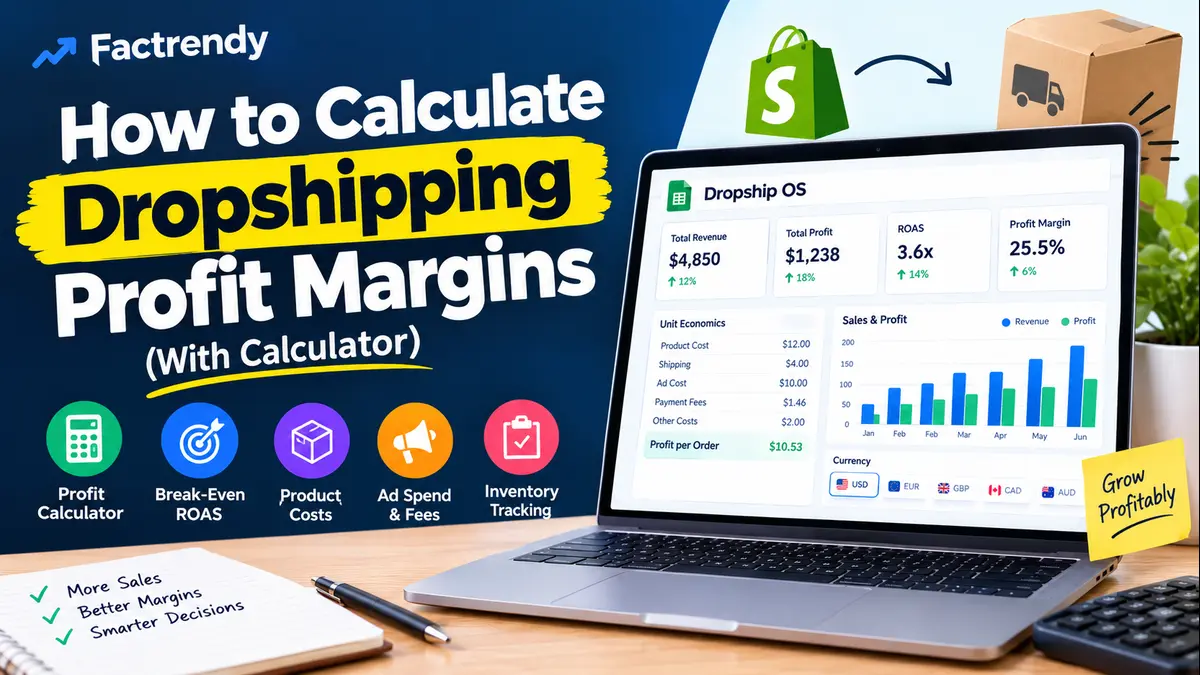
DROPSHIP OS is a dropshipping spreadsheet system designed to help sellers organize key business numbers, including:
- Unit economics calculator: estimate net profit, break-even ROAS, CPA, and payment gateway fees.
- Inventory OS and SKU tracker: organize stock, track units sold, and monitor revenue.
- What-if scenario simulator: explore how changes in advertising costs and discounts may affect your numbers.
- Multiple currency support: work with USD, EUR, GBP, CAD, and AUD.
The aim is to make it easier to compare costs and scenarios without rebuilding your own spreadsheet from scratch. You should still verify the figures against your store, supplier, advertising, and payment records.
Explore DROPSHIP OSChoose a tracking setup that fits your store. A simple spreadsheet may be enough when you have only a few orders; a structured system can be more useful as your product catalog and workload grow.
Build a Weekly Profit Review
You do not need to check every number all day. A regular review can help you spot problems before they become expensive.
- Compare recorded orders with payments and refunds.
- Update supplier and shipping costs when they change.
- Review advertising spend and cost per order.
- Compare estimated profit with the actual result.
- Check inventory before increasing promotion for a product.
- Review available cash and bills due soon.
If you are also working on the wider operation of your business, our small business growth tips and strategies can help you think through practical improvements as your workload increases.
Common Dropshipping Profit Calculation Mistakes
Counting Revenue as Profit
Sales revenue is the money generated from orders, not the amount you keep. Subtract the costs that apply before judging the performance of a product.
Ignoring Advertising Costs
A product may look profitable before ads but lose money once customer acquisition costs are included. Estimate advertising cost per order rather than judging performance from revenue alone.
Using the Listed Price After a Discount
If a customer uses a coupon, calculate revenue using the amount actually charged. The original product price can overstate the result.
Forgetting Payment Fees
Percentage-based fees and fixed transaction charges can add up, especially on lower-priced products. Use the rates that apply to your payment setup.
Confusing Break-Even With a Healthy Profit
Break-even means the costs included in your calculation are covered. It does not necessarily cover monthly overhead, taxes, or other expenses you have excluded. Set a profit target that reflects your actual business needs.
Frequently Asked Questions
1. How do I calculate dropshipping profit?
Subtract product cost, shipping, advertising, payment processing, refunds, and other applicable expenses from the revenue collected per order. The result is your estimated profit per order, based on the costs included.
2. What is a good dropshipping profit margin?
There is no single margin that works for every store. The right target depends on product costs, advertising efficiency, returns, overhead, and your business model. Calculate your own costs and compare the resulting margin with your target.
3. How do I calculate break-even ROAS?
For a simplified order-level estimate, divide the selling price by the amount left after subtracting non-ad costs from that price. If non-ad costs equal or exceed the selling price, there is no positive advertising budget available to break even under those assumptions.
4. Does the calculator include taxes?
No. The calculator does not automatically calculate sales tax, income tax, or other tax obligations. Include relevant costs where appropriate and consult official tax guidance or a qualified professional for your situation.
5. Should I include store subscription costs?
Yes, when estimating overall business profit. You can allocate part of a monthly subscription to each order for planning, but also review the full monthly expense separately and avoid counting the same cost twice.
6. Can a high ROAS still produce a loss?
Yes. High advertising revenue does not guarantee profit. Expensive products, shipping, payment fees, refunds, and other costs can leave little or no money after each order.
7. Is this dropshipping profit calculator free?
Yes. You can use the calculator on this page to estimate profit using your own inputs. It is a simplified planning tool, so compare the estimates with actual order and expense records.
8. When should I use a dedicated dropshipping tracker?
A basic calculator may be enough when you are testing one product. If you are managing multiple SKUs, inventory, ad costs, and changing supplier prices, a structured tracker may make it easier to compare product performance and keep your records organized.
Final Thoughts
Calculating dropshipping profit is not just about subtracting the supplier's price from the selling price. Advertising, shipping, payment processing, refunds, and other costs can change the result significantly.
Start with the calculator above, use realistic figures, and test more than one scenario before committing to a larger advertising budget. Then compare your estimates with actual sales, fees, and expenses as your store grows.
If you only need a quick estimate, this free calculator is a useful starting point. If you want to organize unit economics, break-even ROAS, CPA, inventory, and what-if scenarios in one spreadsheet workflow, you can take a closer look at DROPSHIP OS and decide whether its features fit your needs.
Figures shown in the examples are illustrative, not a guarantee of earnings. Actual profitability depends on your costs, sales, advertising performance, and business circumstances.