
 By
You have a product to sell, a campaign to launch, and customers to reach. But before you can run the campaign, you need ad hooks, persuasive copy, emails, landing page content, and a way to report results.
That is where marketing work starts consuming hours. You might ask ChatGPT to write an ad, receive a generic paragraph, rewrite the prompt, and repeat the process several times before getting anything usable.
The problem is not always the AI tool. Often, it is the instructions and workflow behind it.
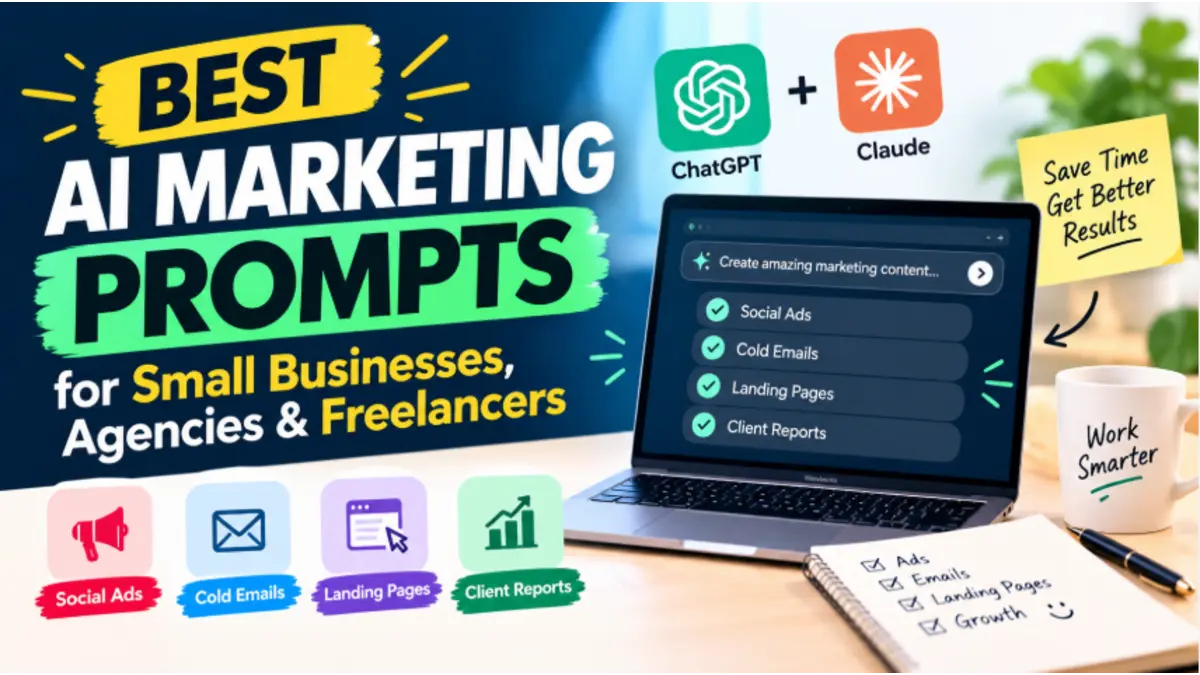
With the right AI prompts for marketing, you can give tools like ChatGPT and Claude a clearer brief, generate more relevant first drafts, and spend less time starting every task from scratch. This guide explains how to do that, with practical prompts you can adapt to your business.
Quick answer: The most useful marketing prompts specify the audience, offer, objective, platform, tone, limitations, and required output. If you regularly create ads, cold emails, landing pages, or client reports, a structured prompt library can help you reuse proven instructions instead of rebuilding them for every task.
What Are AI Marketing Prompts?
AI marketing prompts are instructions that guide an AI tool to complete a marketing task. They can help you develop social media ads, email campaigns, product descriptions, landing pages, outreach messages, content plans, and performance reports.
A basic prompt might say, “Write a Facebook ad for my product.” A stronger prompt explains who the product is for, what problem it solves, why customers should care, what makes the offer different, and what action the reader should take.
That extra context gives the AI a much clearer direction. You still need to review its output, but you are more likely to receive a useful starting point rather than copy that could describe almost any business.
7 ChatGPT Prompts for Marketing You Can Use Today
These examples demonstrate how to approach common marketing tasks. Replace the details in brackets with information about your own business. Treat the results as drafts to test and improve, not guaranteed high-converting copy.
1. Write a Strong Social Media Ad
Use this when you need several ad concepts for a product, service, or online store.
You are a direct-response advertising copywriter. Create three distinct social media ad concepts for (product or service). The target audience is [specific audience], and the main problem we solve is [customer problem]. Our key benefit is [benefit], and the offer is [offer]. For each concept, provide a scroll-stopping opening hook, primary ad text, headline, call to action, and suggested creative direction. Use natural language, avoid exaggerated claims, and make each concept meaningfully different. Explain the audience motivation behind each concept in one sentence.
Why it helps: You get multiple creative directions to evaluate rather than relying on a single version. Test different hooks and offers while keeping other campaign variables controlled where possible.
2. Generate TikTok and Reels Video Hooks
Video ads often need to communicate the problem or benefit quickly. Use this prompt to brainstorm openings before writing the complete script.
Act as a short-form video advertising strategist. My product is , my audience is [audience], and the main buying objection is [objection]. Generate 10 distinct opening hooks for a 15-second TikTok or Instagram Reels ad. Include a mix of problem-focused, curiosity-driven, demonstration-based, and benefit-focused approaches. For each hook, suggest what viewers should see in the first two seconds. Avoid misleading claims, fake testimonials, and unrealistic promises. Select the three strongest concepts and explain why they are worth testing.
Why it helps: You can plan the opening visual and spoken hook together. This makes it easier to develop video concepts that communicate an idea instead of relying on vague attention-grabbing phrases.
3. Write a B2B Cold Email That Sounds Personal
Cold outreach is more useful when it addresses a real business problem. A message that simply praises a company and immediately asks for a meeting often feels automated.
Write three concise B2B cold email variations for my business, [business name]. We help [target audience] solve [specific problem] through [service or product]. The recipient’s role is [job title], and the purpose of the email is [specific goal]. Keep each email under 120 words, use a relevant subject line, explain the value clearly, and finish with a low-pressure question. Do not invent personal details about the recipient, claim that we researched something we have not verified, or use fake familiarity. Make the three versions different in approach.
Why it helps: You establish the audience, value proposition, and next step before generating the email. Always verify personalization details and comply with the email marketing and privacy rules that apply to your recipients.
4. Improve a Landing Page Hero Section
If visitors arrive on your website but do not understand what you offer, your opening section may need a clearer message. Use this prompt to explore alternatives.
Act as a conversion-focused landing page copywriter. My offer is (product or service). The ideal customer is [audience], their main problem is [problem], and the most important benefit is [benefit]. Create five landing page hero-section variations. Each should include a clear headline, supporting subheading, primary call-to-action button, and one short line addressing a likely objection. Make the value understandable without exaggerated promises or unsupported statistics. After the five versions, identify what message each version emphasizes and suggest a simple A/B testing plan.
Why it helps: Instead of changing random words, you can test different value propositions. Keep the audience and offer consistent when comparing headline variations so you can better understand what influences performance.
5. Turn Product Features Into Customer Benefits
Businesses frequently describe what a product contains without explaining why a customer should care. This prompt helps bridge that gap.
My product is [name]. Its features are [list the real features], and its intended customers are [audience]. For each feature, explain the practical benefit, the customer problem it addresses, and a possible marketing message. Then write five short benefit-led product descriptions in different styles: straightforward, problem-solution, convenience-focused, comparison-focused, and story-led. Use only the information supplied. Clearly flag any missing facts rather than inventing product capabilities or customer results.
Why it helps: It gives you several ways to explain the same product without repeating a feature list in every advertisement or product description.
6. Create a Follow-Up Email Sequence
A single email is not always enough to communicate an offer. A carefully planned sequence can provide additional information without sending the same sales pitch repeatedly.
Create a four-email follow-up sequence for (product or service) aimed at [audience]. The reader has [describe the actual situation, such as requesting a demo or downloading a guide]. Give each email a different purpose: clarify the problem, explain the solution, address a common objection, and invite the reader to take the next step. For every email, provide a subject line, concise body, and relevant call to action. Use a helpful tone, avoid fabricated testimonials or urgency, and do not imply that the recipient has taken an action unless that information is known. Include appropriate unsubscribe considerations for marketing emails.
Why it helps: Each message has a defined role, so the sequence can build understanding instead of repeating the same offer four times.
7. Turn Campaign Data Into a Client Report
Marketing agencies and freelancers often need to explain results to clients who do not want to read a spreadsheet full of numbers. AI can help organize the explanation, provided you supply accurate data.
Act as a marketing analyst preparing a client-friendly campaign report. Use only the following verified data: [insert campaign dates, spend, impressions, clicks, conversions, revenue, and other available metrics]. Summarize the main results, calculate relevant metrics where the required inputs are available, compare performance with [previous period or target if supplied], and identify three evidence-based observations. Separate confirmed findings from possible explanations. Highlight missing data, avoid claiming causation without evidence, and recommend three next steps with a reason for each. Format the report with a short executive summary, a metrics table, findings, and recommended actions.
Why it helps: It gives your reporting a consistent structure. Check every calculation and interpretation before sending the report to a client.
Want More Than a Handful of Standalone Prompts?
If you regularly create advertising campaigns, write outreach emails, prepare landing pages, or manage marketing clients, collecting individual prompts can become another task to maintain.
That is why I created the AI Prompt & Workflow Library for Marketers: a structured resource designed to help marketers move from a blank page to a more organized working draft.
The library is built for use with ChatGPT and Claude and covers four practical areas: social advertising, outreach and email sequences, landing pages and funnels, and client onboarding and reporting workflows.
Explore the AI Prompt & Workflow LibraryWhat Should a Useful Marketing Prompt Library Include?
A useful prompt collection should do more than provide dozens of commands. It should help you solve recurring tasks with less setup and make the expected output clear.
For marketers, that means organizing prompts around actual workflows, from developing an offer to creating campaign assets and reporting results.
| Marketing Task | What the Workflow Should Help You Create | What to Review Before Using It |
|---|---|---|
| Social advertising | Hooks, ad copy, creative concepts, and variations | Platform requirements, offer accuracy, audience fit, and claims |
| Cold outreach | Subject lines, personalized messages, and follow-up sequences | Recipient details, relevance, legal requirements, and tone |
| Landing pages | Headlines, value propositions, calls to action, and page sections | Product facts, customer objections, and conversion data |
| Client onboarding | Questionnaires, project steps, and standard operating procedures | Client-specific needs, responsibilities, and deadlines |
| Reporting | Campaign summaries, metrics explanations, and recommendations | Data accuracy, calculations, context, and evidence |
The AI Prompt & Workflow Library for Marketers is organized around these four main modules:
- High-Converting Social Ads: Meta and TikTok hooks, frameworks, and script prompts.
- Cold Outreach & Email Sequences: B2B cold emails, launches, and retention flows.
- Landing Page & Funnel Copywriting: Hero sections, video sales letter scripts, and opt-in pages.
- Client Onboarding, SOPs & Reporting: Questionnaires, ROI reporting, and agency workflows.
The library includes the source material in Markdown format, making it practical to copy, adapt, and organize in compatible tools such as Notion, Google Docs, or a text editor.
How to Get Better Results From ChatGPT and Claude
Even a well-written prompt cannot compensate for missing business information. If you want useful output, give the AI enough context to understand the job.
1. Define the Audience Before Requesting Copy
“Write an ad for my product” leaves too much open to interpretation. Explain who is most likely to buy, what they need, and what problem your product addresses. If your audience has different needs, create separate versions rather than trying to speak to everyone at once.
2. Explain the Offer and Its Limits
Share the real price, features, delivery details, guarantee terms, or other relevant information. Tell the AI not to invent benefits, customer reviews, performance figures, or product capabilities. Verify the final copy against your actual offer.
3. Specify the Output Format
Ask for the exact deliverable you need. For example, request three hooks, two headlines, one primary text, and one call to action. For a report, specify the metrics, summary length, and recommendations. Clear output requirements make drafts easier to compare and edit.
4. Ask for Different Approaches, Not Just More Versions
Ten nearly identical headlines do not necessarily give you ten useful ideas. Ask for distinct approaches, such as problem-focused, convenience-focused, demonstration-led, or objection-handling copy. This gives you a broader set of concepts to evaluate.
5. Use Real Results to Improve the Next Draft
Once a campaign has collected enough data, provide the relevant performance information and ask the AI to identify patterns worth investigating. Do not automatically assume that a high click-through rate means more sales or that one successful campaign will perform the same way with another audience.
For broader business planning, you can also read Factrendy’s guide to small business growth tips and strategies. It covers practical areas such as marketing, pricing, customer retention, and business profitability.
How to Fit AI Prompts Into Your Marketing Workflow
The real benefit comes when prompts become part of a repeatable process instead of isolated experiments.
- Start with a brief: Record the campaign goal, target audience, offer, budget, and main message.
- Generate ideas: Use prompts to explore different hooks, angles, and messages.
- Select the strongest drafts: Remove generic, inaccurate, or unsuitable output.
- Apply your brand voice: Edit the language so it sounds consistent with your business.
- Verify the details: Check prices, features, statistics, claims, links, and any required disclosures.
- Publish and measure: Use real campaign results to decide what deserves another test.
- Save what works: Keep useful prompts and instructions organized so the next project starts faster.
This process can be especially helpful for freelancers and agencies managing multiple clients. A consistent starting framework can reduce repetitive setup while leaving room for each client’s audience, brand, and objectives.
If you are exploring AI as a business opportunity, Factrendy also has a guide on becoming an AI consultant for small businesses. It is a useful next read if you want to investigate services that help businesses adopt AI in their operations.
Who Can Benefit From an AI Prompt and Workflow Library?
Digital Marketing Agencies
Agencies often repeat similar processes across clients: writing briefs, developing campaign concepts, preparing landing page copy, and producing reports. A structured library can give team members a common starting point while still allowing client-specific customization.
Freelance Marketers and Copywriters
Freelancers may need to switch between advertising, email marketing, content, and client communication throughout the day. Reusable workflows can make it easier to start tasks consistently without using the same generic message for every client.
Media Buyers and Performance Marketers
People running campaigns on Meta, TikTok, or other advertising platforms can use prompts to develop creative variations, organize testing ideas, and summarize performance data. AI-generated ideas still need to be checked against platform policies and actual campaign results.
E-Commerce Founders
Online store owners frequently need product descriptions, paid social ads, promotional emails, and landing page updates. Prompts can help them prepare initial drafts without hiring a copywriter for every small task, although important campaigns may still benefit from specialist review.
Is a Paid Marketing Prompt Library Worth It?
It depends on how often you use AI and how much time you currently spend building prompts, correcting generic answers, and organizing your marketing work.
If you only need one occasional social media caption, free prompts may be enough. If you repeatedly produce ads, outreach sequences, landing pages, and client reports, a structured resource may be more useful because it brings related workflows together.
Before buying any prompt product, consider these questions:
- Does it match your work? Check whether it covers the tasks you actually perform.
- Can you customize it? You should be able to adapt the instructions to your audience, brand, and offer.
- Is the format convenient? Markdown files are easy to read and copy into compatible writing or note-taking tools.
- Will you use it regularly? A library has little value if it does not fit your normal process.
- Does it promise realistic outcomes? Prompts can support your work, but they cannot guarantee sales, conversions, or campaign profitability.
The AI Prompt & Workflow Library for Marketers is designed for people who want a more organized collection of marketing prompts covering ads, emails, landing pages, and agency workflows. Review the product page for the current price and purchase details before deciding whether it fits your needs.
Common Mistakes to Avoid When Using AI for Marketing
- Publishing the first draft: AI output needs editing, fact-checking, and a review for brand fit.
- Giving vague instructions: Missing audience and offer details often lead to generic copy.
- Inventing customer evidence: Never present generated testimonials, statistics, or results as real.
- Ignoring platform rules: Review advertising policies and applicable laws before launching campaigns.
- Using the same message everywhere: Different platforms, audiences, and stages of the buying journey may need different approaches.
- Expecting prompts to replace strategy: A prompt can help create copy, but it cannot fix an unclear offer, poor product-market fit, or a weak customer experience by itself.
Frequently Asked Questions
What are the best AI prompts for marketing?
The most useful prompts depend on your task. Common examples include prompts for social media ads, TikTok hooks, cold emails, landing page copy, product descriptions, follow-up sequences, and client reporting. Strong prompts specify the audience, objective, offer, format, and limitations.
Can I use ChatGPT for digital marketing?
Yes. ChatGPT can assist with brainstorming campaigns, drafting ad copy, outlining landing pages, writing emails, planning content, and summarizing supplied data. Review its output for accuracy, originality, brand fit, and compliance before publishing.
Are marketing prompts compatible with Claude?
Many text-based marketing prompts can be adapted for Claude and ChatGPT. Results may differ between models, so adjust your instructions and review the output rather than expecting identical responses.
Can AI prompts help improve ad performance?
Prompts can help you explore creative angles, write alternative messages, and structure experiments. Actual performance depends on factors such as the offer, audience, creative execution, landing page, competition, and campaign setup. Test your ideas using real data.
What is included in the AI Prompt & Workflow Library for Marketers?
The library covers social advertising, cold outreach and email sequences, landing pages and funnels, and client onboarding, standard operating procedures, and reporting workflows. It is designed for ChatGPT and Claude and includes Markdown source files.
Who should consider buying a marketing prompt library?
It may suit marketing agencies, freelancers, media buyers, performance marketers, and e-commerce founders who regularly create marketing materials and want reusable starting points for recurring tasks. People who only need occasional copy may be comfortable using free prompts instead.
Build a More Repeatable Marketing Workflow
You do not need another AI tool for every marketing task. Sometimes the bigger improvement comes from organizing the instructions you already use and making each step easier to repeat.
If your work regularly includes ad creatives, outreach emails, landing pages, or client reporting, explore the AI Prompt & Workflow Library for Marketers to see whether its four modules fit your process.
View the Prompt & Workflow LibraryDisclosure: This article contains a promotional link to a product created by the author. Review the product page for current pricing and details before purchasing.