

 By
By You do not need a college degree or computer science background to become an AI consultant for small business. What you need is practical AI knowledge, an understanding of business problems, a small portfolio that proves what you can do, and the ability to turn those skills into measurable business results. Current 2026 career guidance also emphasizes hands-on projects, specialization, and documented results over formal degrees.
The easiest path is not to learn every AI technology. Pick one type of small business, learn the AI tools that solve its common problems, build 2–3 realistic projects, and use those projects to get your first client.

To impress your client, you want to show yourself as a pro. If you don’t have any idea about small business growth, read this: Small Business Growth Tips & Strategies
Can You Become an AI Consultant Without a Degree?
Yes. A degree is not a mandatory requirement for AI consulting.
AI consulting is different from AI research or machine-learning engineering. A small business usually needs someone who can identify repetitive work, choose an appropriate AI solution, set up a useful workflow, train employees, and explain the business value.
Upwork’s 2026 guide specifically states that certifications are not mandatory and that consultants can build credibility through hands-on projects and documented results.
What Small Businesses Actually Pay You For
A business owner is rarely interested in whether you know the mathematical details behind a large language model.
They are more interested in questions such as:
- Can you reduce the time spent answering customer emails?
- Can you automate lead follow-ups?
- Can you turn long documents into useful summaries?
- Can you help employees use ChatGPT safely?
- Can you create an AI-powered customer support workflow?
- Can you automate repetitive reporting?
- Can you improve their content production process?
- Can you connect AI with the tools they already use?
The result matters more than the certificate.
What Does an AI Consultant for Small Business Do?
An AI consultant for small business helps an owner identify practical opportunities to use artificial intelligence and then turns those opportunities into workable systems.
That can include strategy, workflow redesign, AI tool selection, automation, employee training, implementation, and ongoing support. Current small-business consulting offers commonly focus on workflows such as customer support, documents, invoices, marketing, reporting, and lead management.
Common AI Consulting Services
ServiceWhat You Help WithExample
AI audit Find repetitive AI opportunities Review a company’s daily workflows
AI strategy Decide what to implement first Create a 90-day AI roadmap
Workflow automation Reduce manual work Automate lead follow-ups
AI content systems Speed up content production Create repeatable content workflows
Customer support AI Improve response handling Draft and classify customer emails
Document processing Extract useful information Summarize contracts or forms
AI training Teach employees practical AI use Team ChatGPT workshop
AI tool selection Choose suitable software Compare AI platforms
AI implementation Put the system into operation Connect AI with existing tools
Ongoing consulting Monitor and improve systems Monthly AI advisory
You do not have to offer all ten services when starting, beginner can start with one problem and one service.
How to Become an AI Consultant for Small Business With No Degree
The following roadmap is designed for someone starting without a formal AI qualification.
Step 1: Learn How Businesses Actually Use AI
Don’t start by trying to learn everything about artificial intelligence.
Start with the business problems AI can solve.
For example, imagine a 10-person property management company. Employees might spend hours answering similar tenant questions, organizing documents, writing emails, updating spreadsheets, and following up with leads.
You could identify those tasks and ask:
Which tasks are repetitive, text-heavy, rules-based, and expensive in employee time?
Those are often better starting points than trying to sell a complicated custom AI system.
Learn These AI Fundamentals
You should understand:
- Large language models
- Prompting
- Context windows
- AI agents
- Retrieval-augmented generation (RAG)
- AI automation
- APIs at a basic level
- Data privacy
- Hallucinations and accuracy problems
- Human review
- AI tool limitations
- Workflow automation
- Basic ROI calculation
You don’t need to become an AI researcher.
You need enough technical understanding to know what a tool can do, what it cannot do, and when it should not be used.
Step 2: Master 2-3 AI Tools First
One common mistake is collecting dozens of AI subscriptions without becoming good at any of them.
Start with a small stack. For example: Skill Area: What to Learn?
AI assistant ChatGPT, Claude, Gemini or similar
Automation Make, Zapier or similar tools
Documents AI document analysis and extraction
Research AI-assisted research workflows
Content AI writing and editing workflows
Data Spreadsheet + AI workflows
Optional technical skill Basic APIs and webhooks
The specific tools will change over time.
The consulting skill is learning how to connect a business problem to the right tool.
Step 3: Choose a Small Business Niche
This is where a beginner can become much easier to hire.
Say:
“I help real estate agencies automate lead follow-ups and property inquiry workflows with AI.”
Statement gives the client a clear reason to talk to you.
Small Business Niches You Could Target
- Real estate agencies
- Law firms
- Accounting firms
- Marketing agencies
- E-commerce stores
- Dental practices
- Home service companies
- Property managers
- Insurance agencies
- Local retailers
- Recruitment agencies
- Financial service businesses
- Professional consultants
- Construction companies
You don’t have to stay in the same niche forever. Learn Profitable Small Town Business Ideas With AI
Your first niche simply gives you a clearer problem to solve and a clearer message to market.
Step 4: Find the Most Expensive Repetitive Tasks
This is one of the most important skills for an AI consultant.
First map the workflow. Ask:
- What tasks happen every day?
- Which tasks are repeated?
- Which tasks require copying and pasting?
- Which tasks involve large amounts of text?
- Which tasks require employees to search for information?
- Where do leads get lost?
- Where are employees waiting for information?
- Which reports take too long to create?
- Which customer questions are repeated?
- Which processes already use digital data?
Then calculate the approximate cost.
Simple ROI Example
Suppose an employee spends:
2 hours per day handling repetitive customer emails.
If the employee works 22 days per month:
2 × 22 = 44 hours per month
If the company’s estimated labor cost is $25 per hour:
44 × $25 = $1,100 per month
You now have a business conversation.
You can say:
This workflow currently consumes approximately 44 employee hours per month. Let’s test whether AI can reduce the manual portion without removing human review.
That sounds like consulting.
Step 5: Build Your First AI Consulting Projects
You don’t need five paying clients before creating a portfolio.
Build realistic demonstration projects.
Project 1: AI Lead Follow-Up System
Create a workflow where:
New lead → information captured → AI categorizes lead → personalized draft response → human approval → follow-up reminder
You can demonstrate the process using sample data.
Project 2: AI Customer Support Assistant
Build a demonstration that:
- Receives a customer question
- Finds relevant information
- Drafts an answer
- Flags uncertain questions
- Sends the response to a human for approval
Project 3: AI Document Workflow
Create a system that takes a document and:
- Extracts important information
- Summarizes it
- Identifies missing information
- Produces a structured output
- Sends the result for human review
These projects demonstrate business thinking, not just prompt writing.
Step 6: Create an AI Consulting Portfolio
Your portfolio doesn’t need to be a complicated website.
A simple page can be enough.
For every project, show:
The Problem
What was taking too much time or creating friction?
The Old Workflow
Explain how the process worked before AI.
The AI Solution
Show what you changed.
The New Workflow
Explain how the process works now.
The Result
Use real measurements whenever you have them.
For example: “The demonstration reduced the number of manual steps from 9 to 4.”
That is much stronger than: “This revolutionary AI system improves productivity.”
Never invent client results. If it is a demonstration project, clearly label it as a demo.
Step 7: Get Your First Client Without Experience
Don’t wait until you feel completely ready, start with businesses where you can understand the problem.
Method 1: Local Businesses
Search Google Maps for businesses in your chosen niche.
Look for companies with:
- Active websites
- Online forms
- Multiple customer inquiries
- Reviews mentioning slow responses
- Manual booking processes
- Large service menus
- Active social media accounts
Create a short observation about one workflow.
Then contact the owner.
Method 2: Freelance Platforms
Platforms such as Upwork can be used to find small AI automation, consulting, research, and workflow projects. Upwork’s current guidance recommends building practical examples and starting with smaller freelance projects when developing experience.
Method 3: Direct Outreach
A short message is usually better than a 1,000-word sales pitch.
Example:
I noticed your team handles a lot of customer inquiries manually. I built a simple AI workflow that can classify inquiries and draft responses for human approval. I can show you the workflow using a few sample inquiries if you’d like.
You’re selling a solution to a problem, not “AI.”
Step 8: Offer a Small Pilot Before a Large Project
A beginner doesn’t need to sell a $20,000 AI transformation project.
Start with a narrow problem.
For example:
AI Email Triage Pilot
Deliverables:
- Workflow audit
- AI classification system
- Response templates
- Human approval process
- Testing
- Documentation
- Employee training
A small pilot reduces risk for both sides.
If it works, the client can expand the project.
AI Consultant Market Info:
How Much Can an AI Consultant Charge?
There isn’t one universal AI consulting price.
Current 2026 market guides show a wide range depending on experience, scope, implementation complexity, and whether the consultant is an individual or larger firm. Published small-business benchmarks include hourly advisory rates around $100–$300, fixed-scope projects in the thousands of dollars, and larger implementation engagements substantially above that.
For a beginner, the more useful question is:
What is the smallest clearly defined outcome I can deliver successfully?
Example Beginner Offer Structure
Offer Possible Deliverable
| Offer | What You Deliver | Best Use |
|---|---|---|
| AI Workflow Audit | Identify 3–5 practical AI opportunities | Find where AI can save time or reduce repetitive work |
| AI Quick Win | Implement one small AI workflow | Give a business a low-risk first AI project |
| AI Training | Train a small team to use AI effectively | Help employees adopt AI tools |
| Automation Setup | Build one defined automation | Reduce repetitive manual work |
| Monthly AI Advisor | Review workflows and recommend improvements | Provide ongoing AI strategy and support |
Don’t copy another consultant’s price simply because they charge $300/hour.
Price should reflect scope, complexity, risk, expertise, and the value of the work.
Do You Need Coding Skills to Become an AI Consultant?
No, not for every type of AI consulting.
A consultant focused on AI strategy, training, workflow design, tool selection, and no-code automation can start without being a professional programmer.
However, basic technical knowledge becomes increasingly valuable.
Coding Is More Important When You Want to Build:
- Custom AI applications
- API integrations
- AI agents
- RAG systems
- Custom dashboards
- Database integrations
- Production software
- Advanced automation infrastructure
Think of coding as a force multiplier, not the entry ticket.
Do You Need an AI Certification?
No certification is universally required to become an AI consultant.
Certifications can help demonstrate structured learning, but they don’t replace practical evidence.
Upwork’s current career guidance says certifications can help substantiate expertise but are not mandatory.
If you have no degree and no professional experience, a stronger credibility combination can be:
Relevant training + practical projects + portfolio + clear process + client results
How to Calculate AI ROI for a Small Business
A consultant should be able to connect an AI project to numbers.
A simple starting formula is:
Estimated monthly benefit = hours saved × hourly labor cost
AI Consulting ROI Calculator
See how much time and money AI could save a business.
Example
A business spends approximately $1,500 per month on a repetitive process.
Your proposed system costs $3,000 to implement and $100 per month in software.
If the system genuinely reduces the process cost by $700 per month, the business can evaluate whether the expected payback makes sense.
Don't promise ROI before testing the workflow.
Use estimates as estimates and measure the actual result after deployment.
AI Consulting Ideas for Small Businesses
If you're deciding what service to sell, start with problems that are easy to understand.
Sales
- Lead qualification
- Follow-up drafts
- CRM data organization
- Proposal drafts
- Lead summaries
Customer Service
- FAQ assistants
- Email classification
- Response drafting
- Ticket summarization
- Escalation detection
Marketing
- Content workflows
- Social media drafts
- Customer research
- Competitor monitoring
- Email campaign assistance
Operations
- Document processing
- Internal knowledge search
- Report generation
- Meeting summaries
- Data extraction
Finance and Administration
- Invoice data extraction
- Expense categorization support
- Document summaries
- Financial report preparation
- Administrative workflow automation
For financial tasks, keep appropriate human review and controls in place. Don’t treat AI-generated financial outputs as verified financial advice or accounting records.
A 90-Day Roadmap to Become an AI Consultant
You don’t need to spend a year preparing before approaching your first prospect.
A practical 90-day plan can look like this:
Period Main Goal What to Do
Days 1–15 AI fundamentals Learn 2–3 core tools
Days 16–30 Choose niche Pick one business category
Days 31–45 Build Create 2 practical demos
Days 46–60 Portfolio Publish your projects
Days 61–75 Outreach Contact targeted businesses
Days 76–90 Pilot Sell and deliver a small project
This isn’t a guaranteed timeline. Your starting experience, niche, sales ability, and project complexity can change the timeline substantially.
But it gives you something important:
A path from learning to evidence to selling.
How to Position Yourself as an AI Consultant
Avoid generic positioning.
Weak
AI Consultant
Better
AI Workflow Consultant for Small Businesses
More Specific
I help real estate businesses automate lead follow-ups and customer inquiry workflows with AI.
Another Example
I help accounting firms reduce repetitive document and email work with practical AI automation.
The narrower statement gives the business owner a much clearer picture of what you actually do.
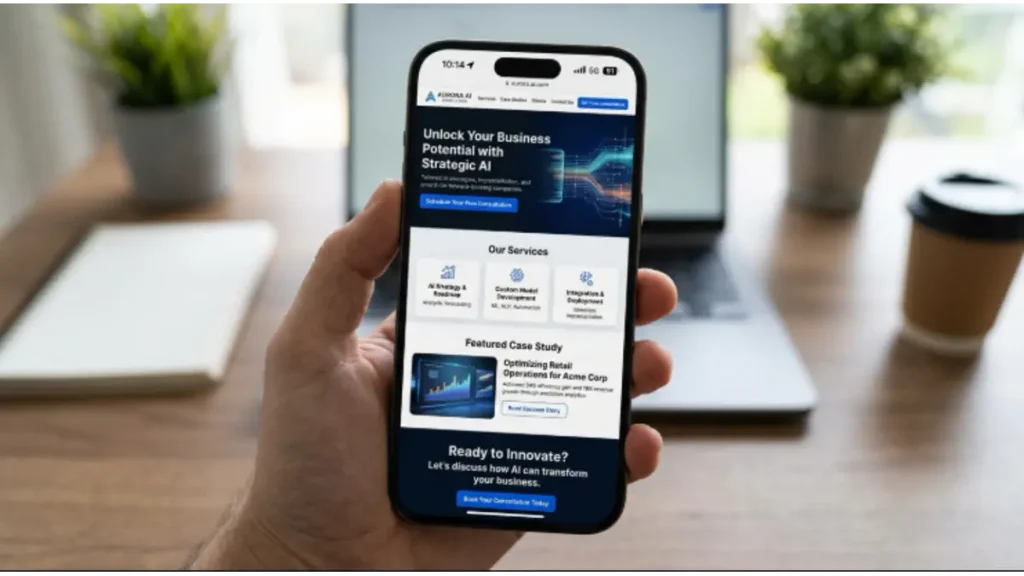
What Should You Put on Your AI Consultant Website?
You don’t need 30 pages. Start with:
Homepage
Clearly explain:
- Who you help
- What problem you solve
- What you implement
- What the client gets
Services
Show your specific offers.
Case Studies
Show real projects and results.
About
Explain your background and why you understand the niche.
Contact
Give visitors one clear next step.
Mistakes New AI Consultants Should Avoid
1. Selling AI Instead of a Business Result
Business owners don’t wake up wanting an AI agent.
They want fewer missed leads, faster responses, less repetitive work, or better processes.
Sell the outcome and explain the AI behind it.
2. Learning Forever
You can spend months watching AI tutorials.
At some point, you need to build something.
Practice should produce portfolio evidence.
3. Offering Everything
Chatbots, AI agents, marketing, SEO, coding, consulting, training, automation, and machine learning all at once can make your positioning unclear.
Start narrow.
4. Making Fake Case Studies
Never invent clients, revenue figures, hours saved, or ROI.
A clearly labeled demo is better than a fake success story.
5. Ignoring Data Privacy
Small businesses may give AI systems access to customer information, contracts, financial documents, employee information, or other sensitive data. You need to understand:
- What data enters the AI system
- Where it goes
- Who can access it
- What should never be uploaded
- When human approval is required
6. Automating a Bad Process
AI cannot magically fix a broken workflow.
Sometimes the correct consulting recommendation is:
Don’t automate this yet. Fix the process first.
That is still valuable consulting.
AI Consultant vs AI Freelancer vs AI Agency
One person can operate in more than one category.
For example, you could start as an AI consultant, then implement the workflows yourself as an AI automation specialist.
How to Get Your First 3 AI Consulting Clients
Don’t make your first goal “100 clients.”
Make it:
Client #1 → Client #2 → Client #3
Client #1
Focus on proving you can deliver.
Client #2
Improve your process and documentation.
Client #3
Turn the first two projects into a repeatable offer.
After each project, record:
- Problem
- Starting process
- Solution
- Tools
- Implementation time
- Human review required
- Measured result
- Client feedback
This becomes your evidence library.
Frequently Asked Questions
The Simple Formula for Becoming an AI Consultant
If you want to remember only one framework, use this:
Learn → Choose → Build → Prove → Pitch → Deliver → Measure → Repeat
Learn
Master a few AI tools.
Choose
Pick one business niche.
Build
Create 2–3 realistic workflows.
Prove
Document exactly what each workflow does.
Pitch
Contact businesses with a specific problem.
Deliver
Start with a small pilot.
Measure
Track time, cost, quality, response speed, or another meaningful metric.
Repeat
Turn the successful project into a repeatable service.
You don’t need a degree to start. You need evidence that you can solve a real business problem.
And that is the difference between someone who simply knows how to use AI and someone a small business can actually hire as an AI consultant.
Can I become an AI consultant without a college degree?
Yes. A degree is not universally required. Practical AI skills, business understanding, portfolio projects, and documented results can establish credibility.
Can I become an AI consultant with no experience?
Yes, but you need to replace professional experience with evidence of your ability.
Build realistic projects, document your process, and start with small engagements.
Do I need to know Python?
No, Python becomes useful for more technical AI implementation, but many consulting services can be delivered through existing AI platforms and no-code or low-code automation tools.
How long does it take to become an AI consultant?
There is no fixed timeline. A person with business experience and strong technical skills may move faster than a complete beginner. Some career guides describe a first paid engagement as a possible goal within roughly 90 days, but that is a target, not a guarantee.
What is the best niche for an AI consultant?
There isn’t one universally best niche.
Choose a market where you understand the problems and can identify repetitive workflows that AI can realistically improve.
Can I work with US small businesses remotely?
Yes. AI consulting can often be delivered remotely through video calls, shared documents, workflow tools, and cloud software.
Is AI consulting still worth in 2026?
More durable skill is understanding business processes and knowing where AI creates measurable value