

 By
By An AI automation micro agency is a small agency, often run by one person, that builds AI-powered workflows for businesses instead of maintaining a large team. You can sell services such as lead follow-up, customer support, appointment booking, CRM updates, reporting, and document processing.
A realistic one-person model can target $150,000 in annual revenue with a small number of recurring clients. The key is not selling hours. It is building repeatable automation systems that solve expensive business problems and grow your business.

What Is an AI Automation Micro Agency?
An AI automation micro agency combines AI tools, workflow automation, integrations, and human strategy to solve repetitive business tasks.
Unlike a traditional agency, you do not need a large staff for every service. One person can handle sales, strategy, client communication, system design, and quality control while AI tools and automation platforms handle parts of the execution.
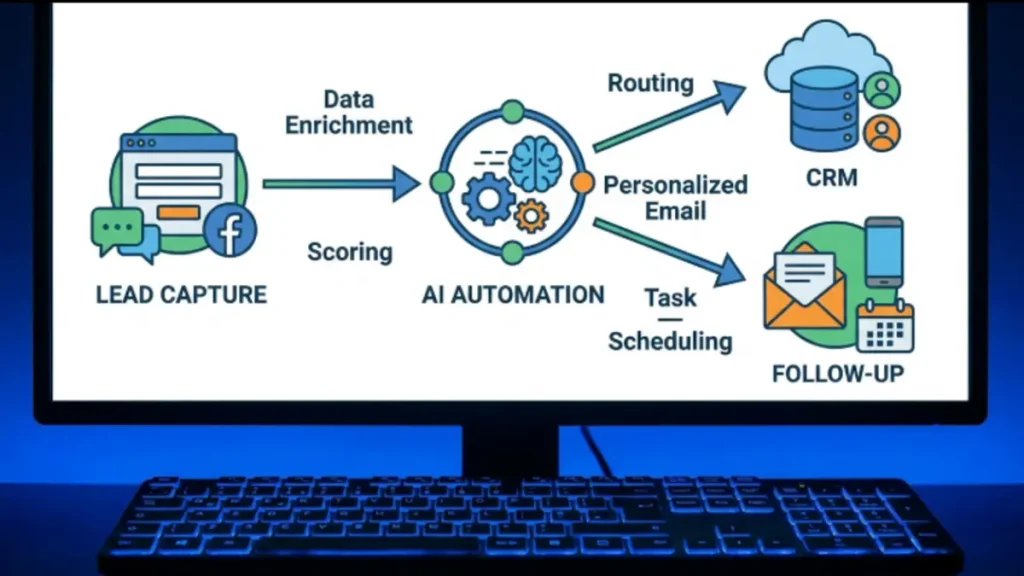
For example, a client might receive a new lead through a website form. An automated system can capture the lead, qualify it, add it to a CRM, send a personalized response, notify the salesperson, and schedule a follow-up.
The human still owns the important decisions and client relationship.
Micro Agency vs Traditional AI Agency
| Factor | AI Micro Agency | Traditional AI Agency |
|---|---|---|
| Team | 1–3 people | Multiple employees |
| Main Advantage | Low overhead | Larger delivery capacity |
| Client Type | Small and mid-sized businesses | Mid-market and enterprise |
| Services | Narrow and specialized | Broad |
| Delivery | Productized workflows | Custom projects |
| Sales | Founder-led | Sales team possible |
| Costs | Relatively low | Higher |
| Scaling | Systems + AI + contractors | Employees + departments |
The advantage of the micro-agency model is focus.
You do not need to promise that you can automate everything. You need to become very good at solving a small number of valuable problems.
Why AI Automation Is a Strong Small Business Opportunity
Small businesses often do not need another complicated AI strategy presentation.
They need practical problems solved.
Examples include:
- Responding to new leads faster
- Following up with prospects
- Booking appointments
- Sending reminders
- Updating a CRM
- Extracting information from invoices
- Creating reports
- Answering repetitive customer questions
- Moving information between software
- Re-engaging old leads
Current AI automation businesses are already selling these types of solutions, including speed-to-lead systems, invoice processing, WhatsApp automation, CRM integrations and workflow automation.
That gives a new micro agency an important lesson:
Sell the business outcome, not the AI technology.
A business owner usually cares more about “more leads followed up” than whether the workflow uses n8n, Make, Zapier, an LLM, or another platform.
How Does an AI Automation Micro Agency Make Money?
There are four simple revenue models.
| Revenue Model | Example |
|---|---|
| Automation setup | $1,500 one-time |
| Larger implementation | $3,000–$10,000+ |
| Monthly maintenance | $300–$1,500/month |
| AI automation retainer | $1,000–$3,000+/month |
These are example business-model ranges, not universal market rates. Current providers show a wide range of pricing, from relatively low-cost SMB packages to several-thousand-dollar fixed-fee automation projects.
For a one-person agency, recurring revenue is especially useful because you do not have to start every month from zero.
The $150K AI Automation Micro Agency Model
The easiest way to understand the opportunity is through simple revenue math.
You do not need hundreds of customers.
For example:
10 clients × $1,250/month = $12,500/month
$12,500 × 12 = $150,000/year
That is $150,000 in gross annual revenue, not $150,000 in personal profit.
Your actual profit will be lower after software, contractors, payment processing, taxes, advertising and other business expenses.
Another Path to $150K
You could also combine setup fees with recurring revenue.
| Revenue Source | Clients | Price | Annual Revenue |
|---|---|---|---|
| Setup projects | 10 | $2,500 | $25,000 |
| Monthly retainers | 10 | $1,000/month | $120,000 |
| Extra projects | 2 | $2,500 | $5,000 |
| Total | $150,000 |
This model is much more realistic than assuming one person can personally complete unlimited custom projects.
The goal is to standardize delivery.
What Services Should an AI Automation Micro Agency Offer?
Do not launch with 20 different services.
Start with one core problem and a few closely related solutions.
1. AI Lead Follow-Up Automation
This can be one of the easiest services to explain to a business owner.
A typical workflow could:
- Receive a new lead.
- Store the lead in a CRM or spreadsheet.
- Send an immediate response.
- Ask qualifying questions.
- Notify the salesperson.
- Create a follow-up task.
- Send reminders if the lead does not respond.
The business is not buying “AI.”
It is buying a better lead response and follow-up process.
2. AI Customer Support Automation
A business may receive the same questions every day.
An AI support system can answer approved questions about:
- Products
- Services
- Pricing
- Opening hours
- Locations
- Policies
- Appointment availability
- Basic order information
A good system should also include human handoff when the question is outside its approved scope.
3. Appointment Booking Automation
This is useful for:
- Dentists
- Clinics
- Salons
- Consultants
- Real estate businesses
- Fitness businesses
- Repair companies
- Professional services
The automation can collect information, check availability, book the appointment and send reminders.
4. Invoice and Document Automation
A workflow can extract information from invoices or documents and move structured data into another system.
For example:
PDF invoice → AI/OCR extraction → validation → spreadsheet/accounting system → notification
Document automation can be particularly valuable when employees repeatedly copy information between files and software.
5. CRM Automation
A micro agency can automate repetitive CRM tasks such as:
- Creating contacts
- Updating lead stages
- Assigning leads
- Adding notes
- Sending follow-ups
- Creating tasks
- Generating summaries
The value comes from reducing administrative work rather than simply adding another AI chatbot.
The Best AI Automation Micro Agency Niche
You will usually have an easier time selling automation when you choose a specific business niche
Potential Niches
| Niche | Automation Opportunity |
|---|---|
| Dental clinics | Lead follow-up + appointment booking |
| Real estate | Lead qualification + follow-up |
| Law firms | Intake + document workflows |
| E-commerce | Customer support + order updates |
| Home services | Lead response + scheduling |
| Marketing agencies | Client reporting + lead management |
| Accountants | Document collection + reminders |
| Recruitment firms | Candidate screening + scheduling |
| Salons | Booking + reminders |
| Local contractors | Quote requests + follow-up |
Pick a niche where one additional customer can be worth significantly more than your service fee.
That makes your ROI argument much easier.
How to Choose a Profitable Automation Problem
Use this simple filter before building anything.
Ask five questions:
- Does the business perform the task frequently?
- Does the task consume employee time?
- Does the task affect revenue or operating costs?
- Can software reliably automate part of it?
- Can the result be measured?
If the answer is yes to most of these, you may have a good automation opportunity.
A task that takes five minutes once a month is probably not a great project.
A task that takes three employees several hours every week could be much more valuable.
How to Start an AI Automation Micro Agency With One Person
You do not need a large website or office to start.
Build the business in this order.
Step 1: Choose One Niche
Pick one type of customer.
For example:
Real estate agencies
Then study their repetitive workflows.
Look for:
- Lead response
- Property inquiries
- Appointment booking
- Follow-ups
- CRM updates
- Reporting
You are looking for a business problem, not an AI trend.
Step 2: Build One Demonstration Workflow
Before trying to sell ten services, build one working demo.
For example:
Website lead → AI qualification → CRM → personalized response → sales notification → follow-up
A prospect can understand a working demonstration much faster than a page full of technical descriptions.
Step 3: Turn the Workflow Into a Product
Do not sell: “I can build custom AI automations.”
Sell something more specific.
For example:
AI Lead Response System
Includes:
- Lead capture
- AI qualification
- CRM entry
- Instant response
- Follow-up sequence
- Staff notification
- Basic reporting
Now your service is easier to price and deliver.
AI Automation Tools for a Micro Agency
You do not need every AI tool available.
Your basic stack can be relatively small.
| Requirement | Possible Tools |
|---|---|
| AI model | OpenAI, Claude, Gemini |
| Workflow automation | n8n, Make, Zapier |
| CRM | HubSpot, GoHighLevel, Pipedrive |
| Database | Airtable, Google Sheets |
| Communication | Email, WhatsApp, SMS |
| Scheduling | Calendly or client scheduling system |
| Documents | OCR/document AI tools |
| Reporting | Google Sheets, Looker Studio |
| Project management | Notion, Trello, ClickUp |
The exact stack should depend on the client’s existing software.
Do not force a client to replace their entire technology stack just because you prefer another tool.
How AI Agents Fit Into a One-Person Agency
AI agents can help with parts of the agency’s internal work, but they should not be treated as unlimited replacements for human judgment.
The important distinction is that the human remains responsible for quality.
For example, an AI system can draft a proposal, but you should review pricing, scope and promises before sending it.
What Can One Person Automate Inside the Agency?
Your own business can become a demonstration of your service.
Automate:
- Prospect research
- Lead collection
- CRM updates
- Meeting summaries
- Proposal drafts
- Client onboarding
- Invoice reminders
- Project notifications
- Reporting
- Support triage
- Internal documentation
The more repetitive internal work you eliminate, the more time you have for sales, strategy and quality control.
AI Automation Micro Agency Pricing
Avoid starting with a complicated pricing menu.
A simple three-level structure works well.
| Package | Example Price | Suitable For |
|---|---|---|
| Starter | $750–$1,500 | One simple workflow |
| Growth | $2,000–$4,000 | Multiple connected workflows |
| Retainer | $500–$1,500/month | Monitoring + improvements |
These should be treated as starting examples, not fixed industry standards. Some current providers publish much higher project fees for complex automation work, while others target small businesses with lower-cost packages.
Do Not Sell Your Time First
If an automation saves a business 30 hours every month, charging only for your development hours can leave money on the table.
Instead, consider:
- Scope
- Complexity
- Business impact
- Risk
- Integration requirements
- Maintenance
- Support
- Expected value
Your pricing should still be defensible and transparent.
How to Get Your First AI Automation Client
You do not need thousands of followers.
You need a list of businesses with a recognizable problem.
Method 1: Personalized Cold Outreach
Find businesses in your chosen niche.
Then identify one workflow that could potentially be improved.
Instead of: “We are an AI automation agency. Do you need automation?”
Try:
“I noticed your business receives customer inquiries through your website. I built a simple workflow that can qualify new inquiries and send them into a follow-up system automatically. I can show you a short demo.”
Method 2: Build Before You Sell
Create a demo for a fictional business in your niche.
Record a short screen video showing:
Problem → Automation → Result
This gives prospects something concrete to evaluate.
Method 3: Offer an Automation Audit
An audit can identify:
- Repetitive tasks
- Manual data entry
- Slow lead response
- Unused software
- Duplicate work
- Follow-up gaps
You can then recommend one automation instead of trying to sell an entire AI transformation.
How to Deliver an AI Automation Project
Use a repeatable delivery process.
1. Discovery
Understand the current process.
Ask:
- What happens when a lead arrives?
- Who handles it?
- What software is involved?
- Where does information get copied?
- What happens if nobody responds?
- What exceptions require a human?
2. Workflow Mapping
Write down the existing process before automating it.
Trigger → Action → Decision → Action → Human Review → Outcome
3. Build
Connect the required tools and AI components.
4. Test
Test:
- Normal cases
- Missing information
- Wrong information
- Duplicate records
- API failures
- AI mistakes
- Human handoff
5. Launch
Start with a controlled rollout rather than immediately automating everything.
6. Monitor
Review the workflow after launch.
Look for:
- Failed runs
- Incorrect AI responses
- Missed leads
- Duplicate actions
- Unexpected costs
Why Human Oversight Still Matters
AI automation is not the same as “set it and forget it.”
An AI system can produce incorrect information, misunderstand unusual requests or fail when an external service changes.
That is why your service should include guardrails and human escalation.
For high-risk workflows, require human approval before actions such as:
- Sending sensitive information
- Approving refunds
- Making financial decisions
- Sending legal communications
- Deleting records
- Making commitments on behalf of a company
The strongest micro agencies do not sell blind automation.
They sell controlled automation.
How to Scale a One-Person AI Automation Agency
Once you have several clients, do not immediately hire five employees.
First document your delivery process.
Create:
- Workflow templates
- Client onboarding forms
- Proposal templates
- Testing checklists
- SOPs
- Reporting templates
- Troubleshooting guides
- Reusable automation components
Then outsource only the work that does not require your highest-value skills.
For example:
You: Sales + strategy + architecture + client relationship
AI: Research + drafts + summaries + repetitive processing
Contractor: Specialized development or design
This keeps the core business small without forcing the founder to do every task manually.
The Biggest Mistake: Building Custom Systems for Everyone
A one-person agency becomes difficult to scale when every client receives a completely different system.
Imagine:
Client A: WhatsApp + CRM + AI
Client B: Email + Salesforce + custom API
Client C: Website + five integrations + voice AI
Client D: Custom database + accounting software
You may technically be able to build all of them, but support becomes difficult.
A better model is to create repeatable solutions for one niche.
For example:
“We automate lead follow-up for home-service companies.”
Now your next client may use a different CRM, but the business process remains similar.
AI Automation Micro Agency Revenue Calculator
Use the following simple model to understand the economics.
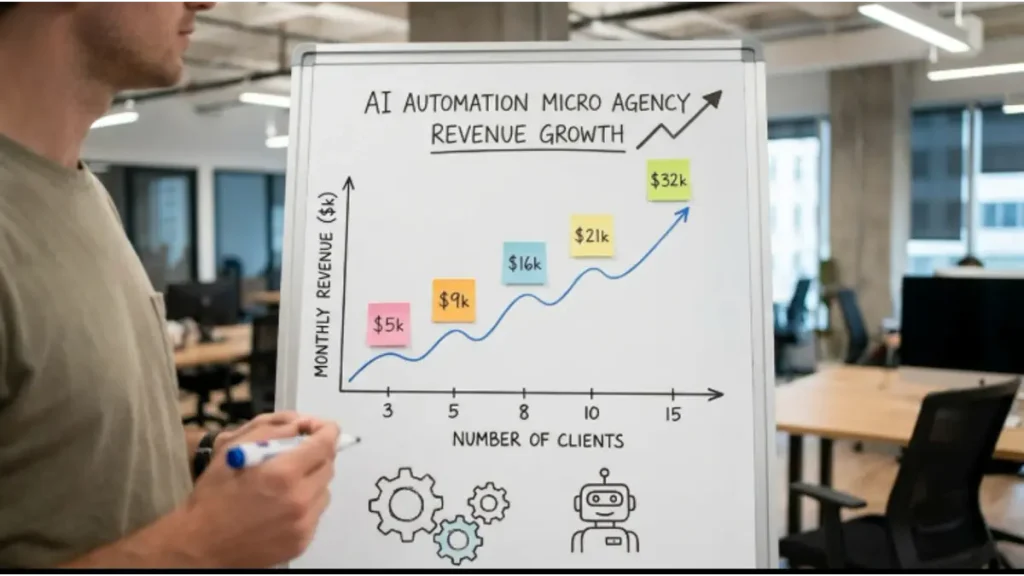
| Clients | Monthly Retainer | Monthly Revenue | Annual Revenue |
|---|---|---|---|
| 3 | $750 | $2,250 | $27,000 |
| 5 | $1,000 | $5,000 | $60,000 |
| 8 | $1,250 | $10,000 | $120,000 |
| 10 | $1,250 | $12,500 | $150,000 |
| 15 | $1,250 | $18,750 | $225,000 |
The important number is not the maximum possible revenue.
It is the number of clients you can realistically support while maintaining quality.
A 10-client business with strong systems can be more attractive than a 30-client business where the founder is constantly fixing broken automations.
Is $150K Realistic for a One-Person AI Automation Agency?
It is possible, but it is not guaranteed.
The $150K example assumes you can acquire and retain around 10 clients at an average of $1,250 per month, or generate equivalent revenue through setup projects and retainers.
The difficult part is not multiplying $1,250 by 10.
The difficult parts are:
- Finding qualified clients
- Proving ROI
- Delivering reliably
- Managing integrations
- Handling support
- Retaining clients
- Preventing scope creep
That is why specialization and productized services matter so much.
What Should You Avoid as a New AI Automation Agency?
Avoid these common mistakes:
Selling “AI” Instead of a Business Result
Bad: “We build advanced AI agents.”
Better: “We automatically follow up with new leads within minutes.”
Offering Too Many Services
Start narrow.
You can expand after you understand your customers.
Charging Too Little
Cheap pricing can attract clients who require excessive support.
Automating a Bad Process
If the existing workflow is broken, automation can simply make the broken process faster.
Ignoring Maintenance
APIs, software and AI models change.
Your pricing should account for monitoring and maintenance when appropriate.
Promising Fully Autonomous AI
Most businesses need controlled automation with human escalation, not an AI system making every decision.
AI Automation Micro Agency vs AI Consultant
These models overlap, but the primary value is different.
| Model | Main Value | Typical Deliverable |
|---|---|---|
| AI Consultant | Strategy | AI roadmap |
| AI Freelancer | Execution | Specific project |
| AI Automation Micro Agency | Systems + execution | Repeatable workflows |
| AI Agency | Larger delivery | Multiple services + team |
| AI Trainer | Education | Workshops and training |
A micro agency can actually combine all of these.
For example, you could charge for an AI workflow audit, sell an automation implementation, and then retain the client for monthly optimization.
A Simple 90-Day AI Automation Agency Plan
Days 1–30: Build
Focus on:
- Choose one niche
- Identify one expensive repetitive problem
- Build one demo
- Create one landing page
- Create one service package
- Prepare an outreach list
Do not spend the entire month designing your logo.
Your first objective is proof of demand.
Days 31–60: Sell
Contact potential clients every week.
Use:
- Personalized email
- Local business outreach
- Referrals
- Short demo videos
- Networking
- Industry communities
Track:
- Prospects contacted
- Replies
- Calls booked
- Proposals sent
- Deals closed
Days 61–90: Systemize
Once you have customers:
- Document delivery
- Create templates
- Build reusable workflows
- Add monitoring
- Create case studies
- Introduce monthly support
Your goal is to make client #5 easier to deliver than client #1. Read related guide: AI Consultant for Small Business
Frequently Asked Questions
What is an AI automation micro agency?
An AI automation micro agency is a small service business that uses AI and workflow automation to solve repetitive business processes. It can be operated by one person or a very small team.
Can one person run an AI automation agency?
Yes. A solo operator can handle strategy, sales and client relationships while using automation, AI tools and contractors for parts of delivery.
The challenge is maintaining quality as the client count increases.
How much can an AI automation micro agency make?
There is no fixed income level. A business with 10 clients paying an average of $1,250 per month would generate $150,000 in annual recurring revenue before expenses.
That is a revenue example, not a guarantee or expected salary.
What tools should an AI automation agency learn?
Start with one workflow automation platform, one or two AI model providers, a CRM, spreadsheets/databases and the communication tools used by your target customers.
Learning every tool at once is unnecessary.
How much should an AI automation agency charge?
Pricing depends on scope, integrations, complexity, risk, support and business value.
How do AI automation agencies get clients?
Common channels include personalized cold outreach, referrals, LinkedIn, local networking, partnerships and demonstration videos.
Final Takeaway
An AI automation micro agency is one of the simplest ways to enter the growing AI services market without building a traditional agency with a large team.
A $150K annual revenue target can be modeled with 10 clients paying an average of $1,250 per month, but reaching that number requires strong sales, reliable delivery and client retention.
Start with one workflow.
Prove that it works.
Turn it into a repeatable offer.
Then use AI and automation to make your own agency more efficient before trying to scale it.