
 By
Running Facebook and Instagram ads is relatively easy. Building a campaign structure that produces consistent results without wasting your advertising budget is much harder.
Small businesses and marketing agencies often struggle with campaign organization, ABO vs. CBO decisions, creative testing, increasing budgets, and diagnosing rising acquisition costs.
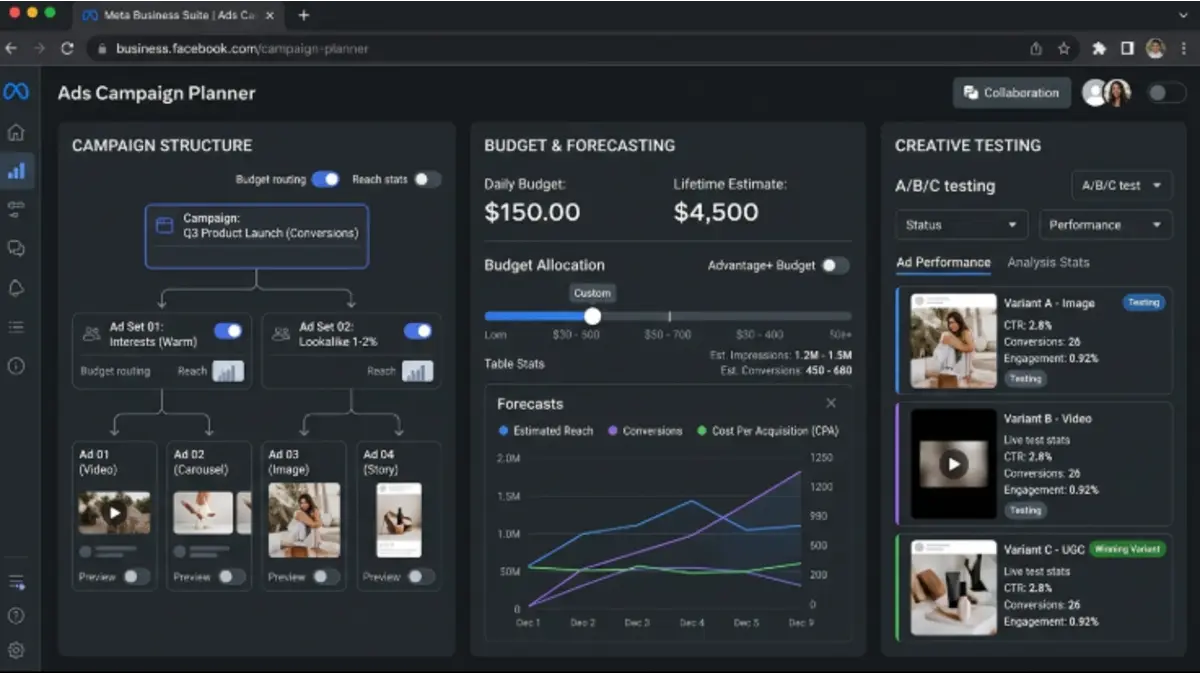
This guide explains how to approach these problems with a practical Meta Ads campaign setup framework. You’ll also find a free interactive campaign planner to estimate budgets and organize creative tests.
1. Why Meta Ads Campaigns Often Fail to Scale
A campaign can generate clicks and still fail to produce profitable customers. This usually happens when advertisers focus on launching ads without building a proper testing and measurement process.
Some common problems include:
- Creating too many campaigns and ad sets with limited budgets.
- Choosing the wrong conversion objective.
- Testing several creatives without a clear strategy.
- Increasing budgets before checking actual profitability.
- Pausing advertisements without enough performance data.
- Ignoring creative fatigue and changes in CPA.
- Failing to investigate landing page and tracking problems.
The solution is not necessarily to spend more. It is to understand where the campaign is losing efficiency and make decisions based on reliable information.
2. Understanding Meta Ads Campaign Architecture
Meta Ads Manager organizes advertising into three main levels: campaigns, ad sets, and ads.
Campaign Level
The campaign level defines your advertising objective and budget approach. Depending on your goal, you might choose sales, leads, engagement, or another suitable objective.
Ad Set Level
Ad sets control important delivery settings, including audiences, placements, schedules, optimization, and sometimes individual budgets.
Ad Level
This is where your creative appears. It includes the video or image, primary text, headline, offer, and call to action.
| Level | Main responsibility |
|---|---|
| Campaign | Advertising objective and budget strategy. |
| Ad Set | Audience and delivery settings. |
| Ad | Creative, messaging and offer. |
A common mistake is creating multiple campaigns for every small audience or creative variation. This can fragment the available budget and make performance difficult to evaluate.
Start with the simplest structure that allows you to answer the advertising question you are testing.
3. ABO vs. CBO: Which Is Better?
ABO means Ad Set Budget Optimization in common advertising terminology. CBO refers to Campaign Budget Optimization. Meta now uses terminology such as Advantage+ campaign budget for its campaign-level budget option.
Both approaches have advantages, depending on the account and testing objective.
| Feature | ABO | CBO |
|---|---|---|
| Budget control | Individual ad set | Campaign level |
| Budget distribution | Advertiser controls allocation | Meta distributes campaign budget |
| Testing | Useful when controlling individual test budgets | Useful when allowing flexible allocation |
| Best consideration | Individual test requirements | Overall campaign performance |
When Should You Use ABO?
ABO can be useful when you want to assign a defined budget to each audience or testing group.
For example, suppose you want to compare two different audience segments. With ad set budgets, you can assign each group a planned amount rather than allowing one group to consume most of the campaign budget.
When Should You Use CBO?
Campaign-level budgeting can be useful when multiple ad sets share the same objective and you want Meta to distribute spending based on delivery opportunities.
However, remember that spending may not be distributed equally. Evaluate the overall campaign performance instead of expecting every ad set to receive the same amount.
4. How Much Budget Do You Need for Meta Ads Testing?
There is no universal minimum advertising budget that guarantees successful learning or conversions.
Your budget should reflect the expected cost per result, available conversion data, business margins, and the number of tests you want to conduct.
For example, if your target cost per lead is $20 and your daily budget is $20, dividing that amount across several ad sets may leave each test with very little data.
This is why budget planning should happen before launching a campaign.
FREE INTERACTIVE TEMPLATE
Meta Ads Campaign Budget Planner
Use this free calculator to estimate weekly advertising spend, potential results at your target CPA, and budget distribution.
This calculator provides estimates, not guaranteed results. The scaling percentage is an illustrative planning input, not an official Meta requirement.
5. Creative Testing: How to Find Better Ads
Creative testing is one of the most important parts of a Meta advertising strategy.
Even a well-organized campaign can struggle if its advertisements fail to attract attention or communicate the offer effectively.
Instead of producing several nearly identical advertisements, test different creative concepts.
Creative Ideas Worth Testing
- Problem and solution videos.
- Customer testimonials and social proof.
- Product demonstrations.
- Offer-focused advertisements.
- Before-and-after demonstrations where appropriate.
- Different opening hooks and messaging angles.
- Educational videos explaining product benefits.
Once a creative concept performs well, create variations around its opening hook, visual presentation, offer, or call to action.
Free Creative Testing Log
Use this editable table to record your advertising results.
| Creative / Hook | Spend ($) | Results | Cost Per Result |
|---|---|---|---|
| Problem Solution | 40 | 2 | $20.00 |
| Customer Proof | 35 | 1 | $35.00 |
| Offer Focused | 30 | 0 | — |
Click individual cells to edit them. Use consistent conversion definitions and reporting periods when comparing advertisements.
6. When Should You Pause an Advertisement?
One of the most common mistakes in advertising is pausing advertisements too early.
An advertisement that has spent only a small amount may not have enough data to support a reliable decision.
Before pausing a creative, examine:
- How much has it spent relative to the target CPA?
- Are people clicking the advertisement?
- Are visitors reaching the landing page?
- Is the conversion tracking working correctly?
- Is the offer relevant to the audience?
- Has enough time passed to evaluate performance?
A useful testing framework should define evaluation conditions before launching advertisements. Avoid using one fixed spending threshold for every business because conversion costs and sales cycles can vary significantly.
7. How to Scale Meta Ads Without Losing Profitability
Scaling means increasing advertising activity while maintaining acceptable business economics.
Before increasing your budget, verify that the campaign is producing results the business can afford.
Check:
- Actual CPA compared with your target CPA.
- Revenue generated from advertising.
- Product or service profit margins.
- Lead quality and actual customer acquisition.
- Creative performance and frequency.
- Website conversion rate.
Understanding Gradual Budget Increases
Some advertisers use gradual increases such as 10% or 20% as a cautious operating approach.
However, these percentages are not universal Meta rules. The appropriate adjustment depends on campaign stability, available conversion data, business risk, and performance.
Avoid increasing budgets simply because an advertisement performed well for one day. Look for consistent results over a meaningful evaluation period.
8. How to Diagnose Rising Meta Ads CPA
CPA means cost per acquisition or cost per action, depending on the conversion being measured.
When CPA increases, immediately rebuilding the entire campaign may make the situation worse.
First, identify which part of the advertising funnel changed.
| Problem | What to Investigate |
|---|---|
| CPM increases | Auction competition, audience and placements. |
| CTR decreases | Creative, hook, message and offer. |
| Clicks remain but conversions fall | Landing page, checkout, form and tracking. |
| Frequency increases | Audience saturation and creative fatigue. |
| Reported conversions suddenly change | Tracking configuration and attribution settings. |
Understanding the source of the problem helps you make a targeted adjustment rather than changing multiple campaign settings without knowing what caused the decline.
9. Daily and Weekly Meta Ads Management Checklist
Daily Checklist
Weekly Checklist
10. A More Structured Meta Ads Management System
Managing one campaign is different from managing multiple campaigns for different clients.
Agencies need repeatable processes for campaign launches, budget planning, creative testing, reporting, and performance troubleshooting.
Without a documented workflow, important decisions can depend too heavily on individual team members.
A standard operating procedure (SOP) helps teams document how campaigns should be organized, how tests should be evaluated, and what to investigate when performance changes.
This is especially useful when several people work on the same advertising account.
ADVANCED RESOURCE FOR SMALL BUSINESSES & AGENCIES
The Meta Ads Scaling & Campaign Setup SOP
Want a more detailed operating framework for campaign architecture, budget testing, creative iteration, scaling decisions and emergency troubleshooting?
The complete SOP covers four main chapters:
- Chapter 1: Campaign Architecture & Account Structure.
- Chapter 2: ABO vs. CBO Masterclass.
- Chapter 3: Creative Testing & Hook Iteration.
- Chapter 4: Scaling & Emergency Protocols.
It is designed for advertisers and agencies who want a more organized approach to managing and improving campaigns.
Get the Premium Meta Ads SOPFrequently Asked Questions
What is the best campaign structure for Meta Ads?
There is no single campaign structure that works for every business. Start with a simple structure based on your objective, available budget, conversion volume and testing requirements.
Should I use ABO or CBO for Facebook Ads?
ABO provides more direct control over individual ad set budgets. CBO, now commonly associated with Advantage+ campaign budget, allows Meta to distribute campaign spending across eligible ad sets. Choose according to your testing needs and campaign objective.
How much budget do I need for Meta Ads?
Your budget depends on your target acquisition cost, business margins, conversion volume and the number of tests you want to conduct. Avoid splitting a small budget across too many ad sets.
How do I scale Facebook Ads?
First establish that your campaign is producing economically acceptable results. Review CPA, conversion quality, revenue, margins and creative performance before gradually increasing spending.
Why is my Meta Ads CPA increasing?
Possible reasons include higher auction costs, weaker creative performance, audience saturation, landing page problems, tracking changes and lower conversion rates. Diagnose the funnel before rebuilding the campaign.
How often should I test new Meta Ads creatives?
Testing frequency depends on your advertising budget, creative volume, audience size and campaign performance. Maintain a regular testing process and introduce new concepts when existing creatives begin losing effectiveness.
Further Reading: More Small Business Marketing Guides
Improving advertising performance is only one part of growing a business. These additional Factrendy guides can help you understand customer acquisition, sales improvement and business automation.
Final Thoughts
Successful Meta Ads management is not simply about launching more advertisements or increasing daily budgets.
It requires a clear campaign structure, reliable conversion tracking, thoughtful creative testing, sensible budget allocation and consistent performance evaluation.
Small businesses should focus on understanding their actual acquisition costs and business margins. Agencies should build documented processes that make campaign decisions easier to evaluate and repeat.
Start with a manageable structure, test with a clear purpose, and scale only when the business results support it.
The goal is not simply to spend more on advertising. It is to make every campaign decision more informed.