
 By
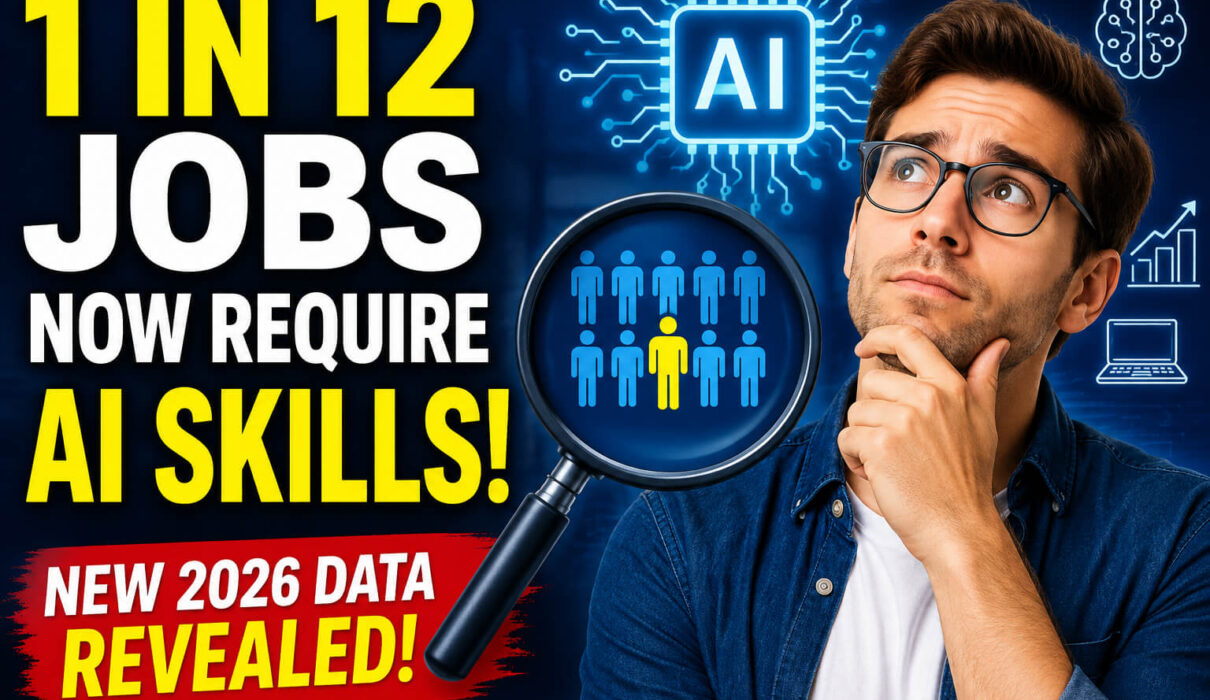
By Around 1 in every 12 job postings worldwide now asks for AI-related skills, according to the 2026 AI Jobs Barometer published. The report, which analyzed more than one billion job advertisements across six continents, shows that employers aren’t simply hiring more AI specialists; they’re increasingly expecting workers across many industries to understand and use AI tools as part of their daily work.
AI-related jobs have grown nearly eight times faster than the overall job market since 2019, making AI literacy one of the fastest-growing workplace requirements.
Not long ago, AI skills were mostly associated with software engineers and machine learning experts. That picture has changed dramatically. Companies are now looking for marketers, recruiters, financial analysts, consultants, and operations professionals who can work alongside AI instead of avoiding it. The latest data suggests AI is becoming less of a specialized field and more of a workplace expectation.
Why Employers Are Asking for AI Skills More Than Ever

The biggest reason is surprisingly simple: businesses are seeing measurable productivity gains from AI adoption.
PwC’s 2026 research found that organizations making the strongest use of AI are growing their workforce faster than companies that have been slower to adopt it. Instead of replacing every employee, AI is helping workers complete repetitive tasks more efficiently, allowing people to spend more time on decision-making, customer interaction, and creative work.
That shift explains why employers are rewriting job descriptions. Rather than asking candidates whether they’ve used a specific AI model, many companies now expect applicants to understand AI-powered workflows, automation tools, prompt engineering basics, or data-assisted decision-making.
The report also highlights another striking trend. Jobs requiring AI skills have experienced roughly 69% growth since 2019, while the overall job market expanded by only about 9% during the same period. That’s one of the clearest signs yet that AI capability has become a competitive hiring advantage rather than an optional bonus.
Entry-Level Workers Are Facing Higher Expectations
One question many people are asking is: why are even junior jobs demanding AI skills?
The answer is that AI is taking over many routine tasks that traditionally helped beginners learn on the job. As those repetitive responsibilities become automated, employers expect new hires to contribute in more meaningful ways from day one.
PwC analyzed approximately 2.4 million entry-level job postings in the United States and found that AI-exposed entry-level roles are now seven times more likely to require skills that previously appeared mainly in senior positions, including judgment, leadership, communication, and strategic thinking. At the same time, job openings for these “seniorized” entry-level positions have grown by 35% since 2019, while other entry-level roles have declined by about 10%.
That’s a noticeable shift from the old career path where graduates gradually developed these abilities after joining the workforce.
Human Skills Are Becoming More Valuable, Not Less
There’s an interesting twist hidden inside the latest numbers.
Although AI is becoming more common, employers are placing even greater value on qualities machines can’t easily replicate. The report repeatedly points to judgment, creativity, leadership, relationship building, and problem-solving as skills becoming increasingly important across AI-heavy industries.
In other words, companies don’t appear to be searching for employees who only know how to use AI tools. They’re searching for people who can combine AI with strong human decision-making.
That combination is creating what PwC describes as a “two-track” labor market. Some jobs are becoming easier because AI simplifies routine work, while others are becoming more specialized because AI allows experienced professionals to focus on higher-value tasks. Those specialized roles are seeing faster hiring growth and stronger wage increases.
What This Means for Job Seekers in 2026
For anyone planning a career move, the message from the data is fairly clear.
Learning how AI tools fit into your profession may soon matter as much as traditional software skills. That doesn’t necessarily mean becoming a programmer or AI engineer. Many employers simply want candidates who understand how AI can improve research, writing, analysis, customer service, project management, or business operations.
The report also notes that workers with AI-related expertise continue to earn higher salaries on average, reflecting strong employer demand for these capabilities. As AI adoption spreads across industries, that advantage could extend well beyond the technology sector.
The workplace isn’t heading toward a future where AI replaces every job. The latest evidence points in a different direction: jobs are evolving, and the people who adapt alongside AI are likely to have the strongest opportunities. With roughly one in twelve job postings already asking for AI skills-and that number continuing to rise-understanding how to work effectively with AI is quickly becoming part of the modern professional toolkit rather than a niche technical specialty.