
 By
By Starting a business in a small town can be challenging. You may have fewer customers than a large city, but you also have something big-city businesses often struggle to build: local relationships.
The profit figures below are planning estimates, not guarantees. They assume a U.S. small-town business with roughly 5,000 to 50,000 residents, owner involvement, and modest operating costs. Actual results will depend heavily on local demand, pricing, competition, labor, insurance, and customer acquisition costs.
In 2026, artificial intelligence can make some of these businesses easier to run without turning them into complicated technology companies. AI can help with scheduling, customer messages, route planning, marketing, demand forecasting, quoting, and repetitive administrative work. Tip: If you’re already running a business, this guide is for you: Small Business Growth Strategies
The opportunity isn’t necessarily to start an “AI business.”
A better approach is to start a normal local business and use AI to operate it more efficiently.
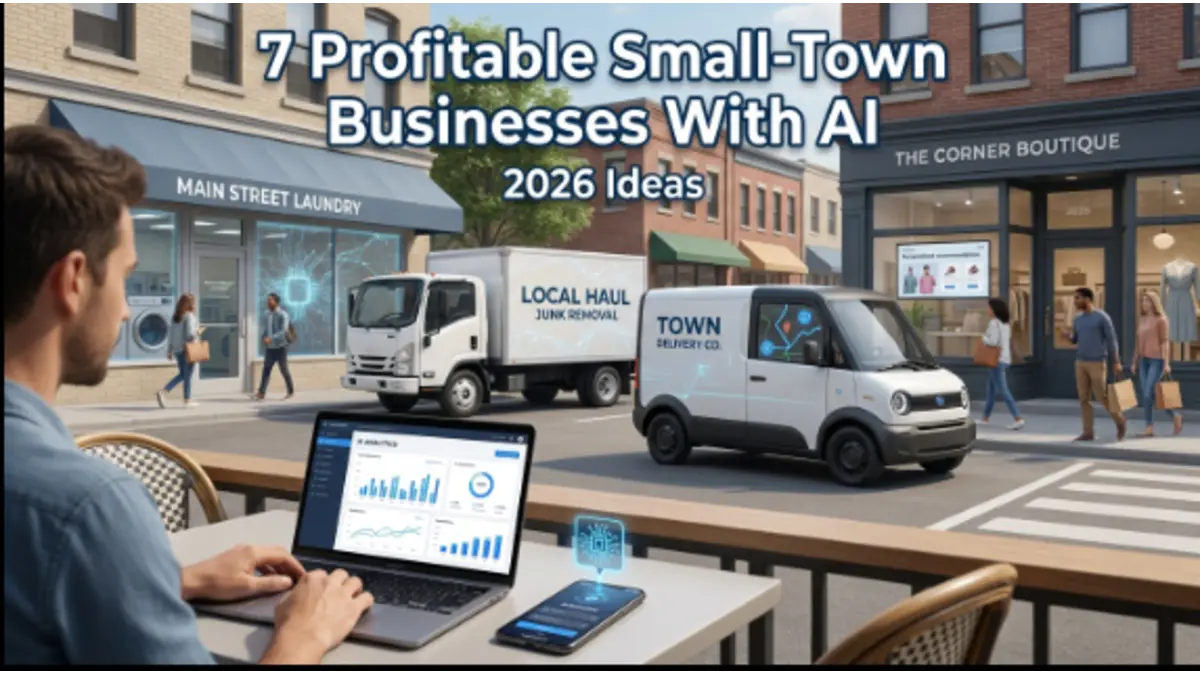
For example, a laundromat can use AI to handle customer questions and monitor operational issues. A junk removal company can use route optimization to reduce unnecessary driving. A local service company can use an AI receptionist to respond to inquiries when the owner is busy.
Quick Comparison: 7 Small Town Businesses Using AI
| Business idea | Startup cost | Monthly revenue | Monthly profit* | AI use |
|---|---|---|---|---|
| AI-assisted laundromat | $80k–$250k+ | $12k–$30k | $3k–$9k | Support Maintenance Demand |
| Junk removal + AI routing | $15k–$45k | $10k–$25k | $3k–$8k | Route Quoting Leads |
| Local cleaning service | $3k–$10k | $8k–$20k | $2.5k–$6k | Scheduling Quotes |
| Mobile pet grooming | $20k–$60k | $8k–$18k | $2.5k–$7k | Reminders Marketing |
| Local AI marketing | $1k–$4k | $5k–$15k | $3k–$10k | Content Ads Reporting |
| Property maintenance | $5k–$20k | $8k–$20k | $2.5k–$7k | Leads Estimates |
| Delivery/errand service | $8k–$25k | $7k–$18k | $2k–$6k | Route Dispatch |
*Estimates before taxes & debt payments.
Here is 7 Profitable Small Town Business Ideas in detail:
1. Start an AI-Assisted Laundromat
A laundromat isn’t a new business idea, but AI can make the traditional model more manageable.
The basic business is still simple: customers pay to wash and dry clothes. The opportunity comes from improving the operation around that service.
AI and automation can help answer common questions, send customer notifications, identify unusual equipment patterns, analyze busy periods, and help an owner understand which machines or services generate the most revenue.
A 2026 guide focused specifically on AI for laundromats describes use cases including automated customer messages, machine downtime management, and reducing owner interruptions. Another 2026 example describes AI being used to support a single-location laundromat for a reported $149 per month, illustrating how small operators can access specialized tools without enterprise-scale technology.
Example economics
Suppose a laundromat generates $20,000 per month in revenue.
If utilities, rent, maintenance, supplies, cleaning, payment processing, and other operating expenses consume approximately $13,000 to $16,000, the remaining operating profit could be around $4,000 to $7,000 before taxes, financing, and major equipment replacement.
The numbers can be dramatically different depending on the building and equipment.
AI tools can help with:
- Customer FAQs
- SMS notifications
- Equipment monitoring
- Demand analysis
- Marketing content
- Review responses
- Customer segmentation
Why it can work in a small town
Laundry is a recurring need. You don’t need thousands of customers every day if you have a convenient location and enough machines for the local population.
The bigger challenge is startup capital. This is not the cheapest idea on this list.
Best for: Someone with access to capital who wants a physical, recurring-revenue business. Read: How much does a laundromat make in 2026? Hope this guide finds you well.
2. Start a Junk Removal Business With AI Route Planning
This is one of the more accessible options.
People in small towns still clean out garages, move houses, renovate properties, remove old furniture, and deal with unwanted appliances.
You don’t need a huge operation to begin.
A pickup truck or trailer, basic equipment, insurance, disposal arrangements, and a simple website can get you started.
The AI opportunity comes after the leads start coming in.
Instead of manually organizing every job, you can use software and automation to:
- Collect customer information
- Estimate job requirements
- Group nearby appointments
- Optimize driving routes
- Send appointment reminders
- Follow up with old leads
- Request reviews after completed jobs
Route optimization is particularly useful because driving is one of the hidden costs of a mobile service business.
Imagine you have six jobs scattered across a county.
A poorly planned schedule might have you crossing the same roads multiple times. A smarter routing system can organize the appointments around geography and available time windows.
Example economics
Suppose you complete:
5 jobs per day × $175 average ticket × 22 working days = $19,250 monthly revenue.
After disposal fees, fuel, insurance, maintenance, advertising, and other operating costs, an owner-operated business might target approximately $4,000–$7,000 in monthly operating profit once the schedule becomes consistently full.
That’s an example model, not a promised return.
AI can help with:
- Route planning
- Lead qualification
- Quote requests
- Follow-up messages
- Review requests
- Marketing content
- Scheduling
Why it works in a small town
A smaller market can actually help here because reputation spreads quickly.
If you’re reliable, answer the phone, arrive when promised, and leave the property clean, customers have a reason to recommend you.
Best for: Someone who wants a relatively low-cost local service business and doesn’t mind physical work.
3. Build an AI-Assisted Local Cleaning Business
Cleaning services are another example where AI doesn’t replace the actual service.
It removes some of the administrative work surrounding it.
You can offer:
- Residential cleaning
- Deep cleaning
- Move-out cleaning
- Short-term rental cleaning
- Small office cleaning
- Post-renovation cleaning
The owner can use automation to collect customer information, estimate jobs, schedule cleaners, send reminders, and follow up after appointments.
A customer shouldn’t have to wait until tomorrow just because you’re currently inside someone’s house cleaning.
An automated response can collect:
ZIP code → property size → cleaning type → preferred date → contact information
You can then review the request and send the final quote.
Example economics
Suppose you have four cleaners completing an average of 5 billable jobs per day at an average ticket of $150.
At 22 working days, that represents:
5 × $150 × 22 = $16,500 monthly revenue
If labor, supplies, transportation, insurance, marketing, software, and other costs total $11,000–$13,000, the business could have roughly $3,500–$5,500 left as operating profit.
The owner’s actual take-home income can be different because the owner may also be working as a cleaner or manager.
AI can help with:
- Instant inquiry responses
- Scheduling
- Quote preparation
- Customer reminders
- Review requests
- Social media content
- Lead follow-up
Why it works in a small town
Cleaning is local and recurring.
One satisfied customer can become a monthly customer for years.
That’s more valuable than constantly finding completely new customers.
Best for: Someone who wants a service business that can start small and add employees over time.
4. Start a Mobile Pet Grooming Business
Pet owners don’t necessarily want to drive across town, wait in a grooming shop, and then make another trip to pick up their dog.
A mobile grooming service brings the service to them.
This can work particularly well in smaller communities where convenience is valuable and there may be fewer specialized providers.
The business requires more specialized equipment than a basic cleaning company, but you can charge a premium for convenience.
Where AI fits
AI isn’t grooming the dog.
It’s helping you manage the business.
For example:
- Online appointment booking
- Automated reminders
- Customer records
- Route scheduling
- Follow-up messages
- Social media content
- Review requests
- Customer reactivation
You could identify customers who haven’t booked for several months and automatically send a friendly reminder.
Example economics
Suppose you average:
6 appointments × $110 × 22 days = $14,520 monthly revenue.
After fuel, vehicle costs, grooming supplies, insurance, maintenance, software, marketing, and other expenses, an owner-operated business might have roughly $3,500–$6,000 in operating profit.
Premium services and higher appointment volume can increase revenue, while vehicle financing and labor can reduce margins.
Why it works in a small town
You aren’t competing only on price.
You’re selling convenience.
A customer may pay more simply because you come to their driveway.
Best for: Someone comfortable working with animals and operating a mobile service vehicle.
5. Start a Local AI Marketing Service
This one requires very little physical infrastructure.
Small-town businesses often know they need better marketing but don’t have enough work to justify hiring a full-time marketing employee.
That’s where a small local AI-assisted marketing service can fit.
You could offer a monthly package covering:
- Social media posts
- Short-form video scripts
- Product descriptions
- Email campaigns
- Google Business Profile posts
- Review responses
- Ad variations
- Basic competitor research
- Monthly reporting
AI can dramatically reduce the time needed to produce first drafts, but the value is not simply “I use AI.”
Your value is understanding the local business and turning that information into marketing that sounds like the actual company.
Current small-business AI usage is already concentrated around practical tasks such as customer communication, content creation, lead handling, and repetitive administrative work. The U.S. Chamber’s 2025 survey, cited by 2026 industry analysis, found that 58% of small businesses reported using generative AI.
Example economics
Suppose you sign 10 local businesses at:
$750/month × 10 = $7,500 monthly revenue.
If software, contractors, advertising, and other operating expenses total around $2,500, you could have approximately $5,000 in operating profit before taxes and owner compensation.
The attraction is that you don’t need 100 clients.
A small number of recurring clients can create a viable service business.
Why it works in a small town
You already have something national agencies don’t:
local knowledge.
You understand the restaurants, contractors, stores, real estate agents, salons, and other businesses around you.
And your customers can actually meet you face-to-face.
Best for: Someone who understands marketing, AI tools, social media, or content creation.
6. Start an AI-Assisted Property Maintenance Business
Small towns often have homeowners, landlords, vacation properties, rental homes, and older buildings that need regular maintenance.
Instead of trying to become a general contractor overnight, choose a narrow service.
For example:
- Lawn maintenance
- Pressure washing
- Gutter cleaning
- Property inspections
- Rental turnover services
- Minor exterior maintenance
- Snow removal where applicable
AI can help organize the business rather than perform the physical work.
A property owner could submit a request online.
The system collects:
Address → service needed → photos → preferred date → contact details
You can then review the request, prepare an estimate, and schedule the job.
Example economics
Suppose you complete 4 jobs per day at an average ticket of $175 for 22 days:
4 × $175 × 22 = $15,400 monthly revenue.
If labor, equipment, fuel, insurance, advertising, and maintenance consume $9,000–$11,500, the remaining operating profit could be around $3,500–$6,000.
The actual result depends heavily on the service.
AI can help with:
- Customer intake
- Estimate templates
- Scheduling
- Route planning
- Follow-ups
- Invoice reminders
- Review requests
- Marketing
Why it works in a small town
Property maintenance is based on a simple advantage:
People own property even when they don’t have time to maintain it.
Landlords can also become recurring customers.
Best for: Someone who prefers hands-on work and wants recurring local clients.
7. Start a Local Delivery and Errand Service
A small town may not have the same delivery infrastructure as a large city.
That creates opportunities for local operators.
You could specialize instead of trying to deliver everything.
For example:
- Pharmacy pickups where legally permitted
- Grocery delivery
- Local store deliveries
- Business-to-business deliveries
- Parts delivery for contractors
- Document delivery
- Senior errands
- Local restaurant delivery
The business becomes more interesting when you stop thinking about individual deliveries and start thinking about routes.
If three customers are going to the same part of town, you want to organize them efficiently.
AI-assisted route planning and dispatching can help reduce wasted miles and improve delivery schedules.
Example economics
Suppose you complete 15 deliveries per day at an average $25 delivery fee:
15 × $25 × 22 = $8,250 monthly revenue.
Additional business-to-business contracts or higher-value deliveries could increase revenue.
After fuel, vehicle costs, insurance, payment processing, software, and other expenses, an owner-operated service might target roughly $2,000–$4,000 in monthly operating profit at this volume.
Why it works in a small town
Convenience matters.
A customer may happily pay $20–$30 to avoid driving 25 minutes each way for a small task.
The key is keeping routes dense enough that you aren’t spending most of the day driving empty.
Best for: Someone with a reliable vehicle who can build relationships with local businesses.
What Makes an AI Business Profitable in a Small Town?
A profitable local business usually starts with a problem people already pay to solve.
For example:
Junk removal + AI routing
The customer pays for junk removal. AI helps reduce wasted driving.
Cleaning + automated scheduling
The customer pays for cleaning. AI helps manage appointments and follow-ups.
Laundromat + automated customer support
The customer pays to use the machines. AI helps reduce repetitive owner tasks.
Marketing service + generative AI
The customer pays for marketing. AI helps you produce and organize the work faster.
This distinction matters because starting a business simply because something has “AI” in the name doesn’t automatically create demand.
How to Choose the Right Small Town Business
Before spending money, answer five questions.
1. What do people already pay for?
Look around your town.
Are there long waits for cleaners, mechanics, pet groomers, contractors, delivery services, or other providers?
Existing demand is usually easier to work with than trying to convince people they need something completely new.
2. Can you get repeat customers?
A $150 one-time sale is useful.
A $150 monthly customer is much more valuable.
Look for businesses with recurring demand.
3. Can AI remove a bottleneck?
Don’t add AI just for marketing.
Find the repetitive task that consumes your time.
It might be:
- Answering the same questions
- Scheduling
- Writing quotes
- Following up with leads
- Planning routes
- Creating social posts
- Sending reminders
- Organizing customer information
That’s where AI has a practical role.
4. Can the town support enough customers?
A small population doesn’t automatically mean a bad market.
You need to estimate the number of potential customers, average ticket, purchase frequency, and realistic market share.
For example, if your town has 10,000 residents and you need only 100 recurring customers, ask whether capturing that number is realistic.
5. Can you start before spending heavily?
This is especially important for first-time entrepreneurs.
Before signing a lease or buying expensive equipment, test demand.
Create a simple website.
Set up a Google Business Profile.
Talk to potential customers.
Run a small local advertising campaign.
Offer the service manually.
If people aren’t willing to pay for the basic service, adding AI won’t fix the business model.
A Simple AI Stack for a Small Local Business
You don’t need 20 AI subscriptions.
A basic setup might include:
| Business task | Technology category |
|---|---|
| Customer questions | AI chatbot or AI assistant |
| Scheduling | Online booking software |
| Route planning | Route optimization software |
| Marketing copy | Generative AI |
| Images/social content | AI-assisted design tools |
| Lead follow-up | CRM automation |
| Reviews | Automated review requests |
| Reporting | Spreadsheet + AI analysis |
The exact tools matter less than the workflow.
In 2026, small businesses are increasingly using off-the-shelf AI for repetitive work instead of building expensive custom systems. Industry examples include customer communication, lead qualification, content generation, scheduling, and operational workflows.
Final Takeaway
The most interesting small-town business opportunities with AI in 2026 aren’t necessarily futuristic.
They are ordinary businesses with a smarter operating system.
A junk removal company can use AI to plan routes.
A cleaner can automate bookings and follow-ups.
A laundromat can automate customer communication and monitor operations.
A pet groomer can organize appointments and customer reminders.
A local marketer can use AI to serve several businesses without building a large agency.
The common thread is simple:
Find a local problem people already pay to solve, then use AI to make the business faster, easier, or more organized.
Start small, measure actual demand, and only add technology when it solves a real bottleneck.
That approach gives you something much more valuable than an “AI business idea”: a local business with a reason to exist.