


 By
Becoming a millionaire when you have little or no money may sound impossible. If your bank account is nearly empty, it is easy to believe that wealth is only available to people who already have money, successful businesses, or wealthy families.
But having no money today does not mean you have no way to build wealth in the future.
When you start from zero, your first valuable asset may be a skill, your ability to work, your knowledge, or even access to a phone and the internet. The goal is not to find a magical way to turn $0 into $1 million overnight. The real goal is to create income, keep more of what you earn, and gradually turn that money into assets.
If you are searching for how to become a millionaire with no money, this guide explains a realistic path you can start following from almost any financial position.
What Should You Learn
Can You Become a Millionaire With No Money?
Yes, you can start building toward millionaire-level wealth without having money at the beginning. However, that does not mean becoming a millionaire is easy, fast, or guaranteed.
Starting with no money means you have less capital available to invest or start a traditional business. That makes your earning ability especially important during the early stages.
Instead of worrying about turning a few dollars into a fortune, focus first on learning something valuable and increasing your income. Once your income becomes higher than your essential expenses, you have money available to save, invest, or use to build a business.
What Does “Starting With No Money” Really Mean?
For most people, starting with no money does not literally mean having nothing at all.
You may have a smartphone, internet access, time, education, work experience, communication skills, or knowledge about a particular subject. These resources can help you create your first source of income.
The important question is not simply, “How much money do I have?”
A better question is:
“What can I use right now to create more value and increase my income?”
That change in perspective can completely alter your approach to building wealth.
How to Become Rich With No Money
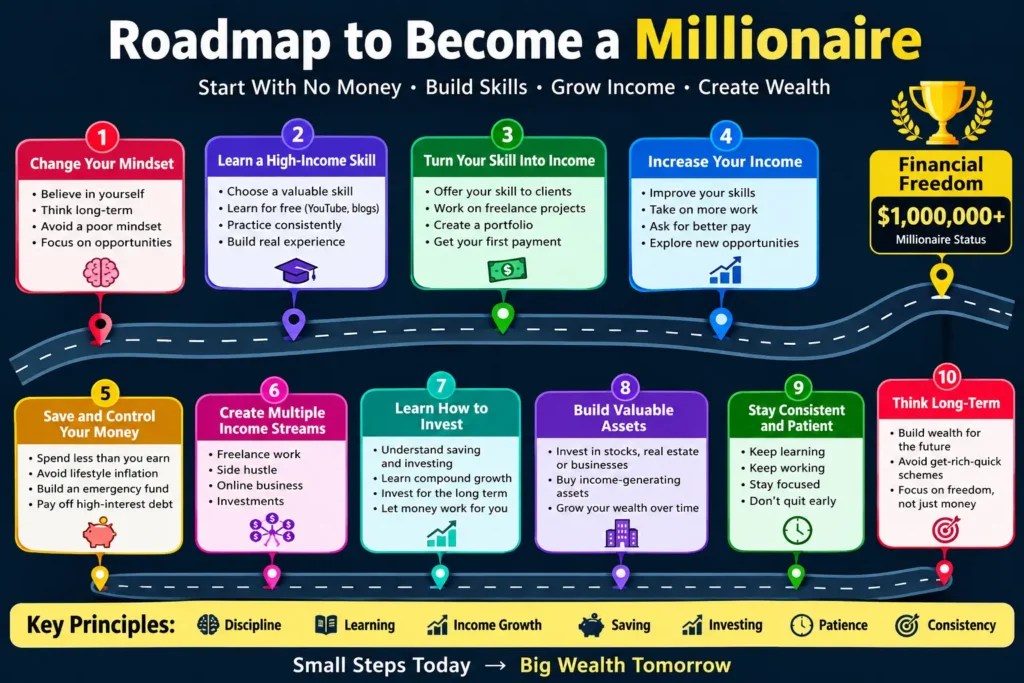
There is no single formula that makes everyone wealthy. But most successful wealth-building journeys involve increasing income, controlling spending, saving consistently, and acquiring assets over time.
Here are the practical steps you can start with.
1. Develop a Wealth-Building Mindset
Your mindset will not make you rich by itself, but it can influence the decisions you make with your money.
If you constantly assume that wealthy people are simply lucky or that improving your financial situation is impossible, you may stop looking for opportunities.
Instead, start thinking about problems you can solve, skills you can develop, and ways you can increase your earning potential.
This does not mean ignoring financial difficulties. It means refusing to treat your current situation as your permanent destination.
2. Learn a High-Income Skill
When you have little or no money, developing a valuable skill can be one of your best starting points.
You can learn many skills online without paying for expensive education. Depending on your interests, you could study video editing, programming, sales, copywriting, SEO, graphic design, digital marketing, or content creation.
Do not try to master ten skills at once.
Choose one that businesses or individuals already pay for, spend time practicing it, and create examples that demonstrate what you can do.
Your first goal is not to become an expert overnight. It is to become useful enough that someone is willing to pay you.
3. Turn Your Skill Into Your First Income
Learning a skill does not automatically create wealth. You need to connect that skill with a real market.
For example, someone who learns video editing could offer short-form video services to creators or businesses. Someone with writing skills could create website content or blog posts for clients.
Your first client may not pay a huge amount, and that is okay.
Your first payment proves something important: your skill can create economic value.
From there, you can improve your work, collect experience, build a portfolio, find better clients, and gradually increase your income.
4. Use the Internet to Find Opportunities
The internet has dramatically lowered the cost of reaching potential customers.
You can use it to find freelance clients, build an audience, promote a service, create content, sell digital products, or develop an online business.
The opportunity isn’t simply having internet access. It is in using that access productively. You can also read our guide, Best Free AI Websites, which can help you make money online.
Instead of spending every free hour consuming content, use some of that time to learn, create, publish your work, contact potential customers, or build something that can eventually generate income.
How to Build Wealth When You Have Very Little Money
Once you start earning, the next challenge is making sure your increased income actually improves your financial position.
Earning more money will not help much if every extra dollar immediately disappears through higher spending.
5. Increase Your Main Income
There is a limit to how much you can save by cutting expenses.
Increasing your income can give you much more room to build wealth.
You might improve your professional skills, apply for better-paying positions, negotiate your salary, take on additional work, or move toward an industry with stronger earning potential.
Think of your income as the engine that powers the rest of your financial plan.
The stronger that engine becomes, the more money you can potentially direct toward savings, investments, and assets.
6. Stop Spending Money to Look Rich
Trying to appear wealthy can actually keep you from becoming wealthy.
Expensive clothes, unnecessary upgrades, luxury purchases, and impulse shopping can consume money that could have been used to improve your financial future.
There is nothing wrong with enjoying money you have earned. The problem is allowing other people’s opinions to control your spending.
Before making an unnecessary purchase, ask yourself whether you genuinely want it or simply want other people to notice it.
Looking rich and being financially independent are not the same thing.
7. Build an Emergency Fund
Before focusing heavily on long-term wealth, try to create some financial breathing room.
Unexpected expenses can appear at any time. A car repair, medical bill, job loss, or urgent household expense can force you into expensive debt if you have no savings available.
If you are starting with almost nothing, do not worry about building a huge emergency fund immediately.
Start with an amount you can realistically save. As your income improves, gradually build a larger financial cushion.
Having emergency savings can help protect the progress you make elsewhere.
8. Pay Down Expensive Debt
Debt is not automatically bad, but high-interest consumer debt can make wealth building much harder.
Credit card balances and unnecessary loans can consume money that could otherwise be used for savings or investments.
Before borrowing, consider the total cost of the debt rather than only looking at the monthly payment.
If you already have expensive debt, reducing it can become an important financial priority. Once less of your income is going toward interest and repayments, you have more flexibility to build assets.
Ways to Create More Income
Increasing your main income is useful, but you do not necessarily have to depend on one source forever.
Additional income can give you more money to save, invest, or reinvest into something that has the potential to grow.
9. Start a Side Income
A side income can begin with something very simple.
You could freelance using a skill you already have, offer a local service, create content, sell digital products, or provide online services to businesses.
Do not feel pressured to create a complicated business immediately.
Start by solving one specific problem for one specific type of customer. Once you understand what people are willing to pay for, you can improve the service and potentially turn it into something larger.
10. Build Multiple Income Streams
Once one additional income source becomes stable, you can consider developing another.
This might eventually include employment income, freelance work, a business, investments, or income from digital assets.
But trying to create five income streams simultaneously can become counterproductive.
Build one reliable source first. Strengthen it. Then diversify when you have the time, skills, and financial stability to do so.
The goal isn’t to complicate your financial life. It is to reduce your dependence on a single source of income. For more information, read our guide on Passive income ideas.
11. Consider Building a Small Business
A business can potentially create more wealth than simply selling your time, but it does not have to begin with a huge investment.
A service business can start with one person, one skill, and a small number of customers.
For example, you could offer marketing, design, writing, editing, consulting, cleaning, repair, or another service where you already have useful skills.
As demand increases, you may eventually be able to improve your systems, increase prices, hire help, or create products that can be sold repeatedly.
The key is to start with a real customer problem rather than chasing whatever business trend happens to be popular. If you already have your business, read our guide on Small Business Growth, for tips
How to Turn Income Into Long-Term Wealth
Making more money is important, but becoming wealthy requires more than a high income.
You need to keep some of what you earn and gradually turn it into assets.
12. Learn How Saving and Investing Work
Saving gives you financial stability, while investing can potentially help your money grow over the long term.
Learn the basics before putting your money into anything you do not understand.
You should know the difference between saving and investing, understand basic investment risk, and recognize that returns are never guaranteed.
If you have expensive debt or no emergency savings, those issues may need attention before aggressive investing.
The objective is not to find the investment that will make you rich fastest. It is to understand how money can potentially grow while managing the risks involved.
13. Invest in Your Earning Power
When you are starting with very little money, investing in yourself can have a significant impact.
Improving your communication, technical abilities, sales skills, business knowledge, or professional expertise can increase your ability to earn more money.
Consider two people who each have $500.
One spends the money trying to make a quick investment return. The other uses part of it to develop a skill that eventually increases their income by hundreds of dollars every month.
The second investment could potentially have a much larger impact on their long-term finances.
Your earning ability is an asset too.
14. Take Calculated Risks
Building wealth often involves uncertainty, but there is a major difference between calculated risk and reckless behavior.
Starting a small business, changing careers, learning a new skill, or investing for the long term can involve risk.
Before making a major decision, consider both the potential reward and the potential loss.
Avoid risking money you cannot afford to lose simply because someone promises unusually high returns.
Good financial decisions are not about avoiding every risk. They are about understanding the risk before you accept it.
15. Stay Consistent for the Long Term
The internet can make wealth look much faster than it really is.
You see someone celebrating a successful business, investment, or career and it can appear as though everything happened overnight.
Usually, you are seeing the result rather than the years of work behind it.
Building wealth can involve failed ideas, rejected applications, slow business growth, changing careers, learning new skills, and financial mistakes.
The people who continue learning and adjusting their strategy have more opportunities to improve than those who quit after a few disappointing months.
What Should You Do If You Have $0 Today?
If your bank account is empty today, do not start by obsessing over the $1 million target.
Start with the first realistic milestone.
$0 → learn a useful skill → earn your first $100 → increase your income → build emergency savings → control debt → invest consistently → acquire assets.
The first stage may take the most effort because you are creating your earning ability from scratch.
Once your income becomes more stable, the focus can gradually shift from simply earning money to keeping and growing it.
Common Mistakes That Prevent People From Building Wealth
One of the biggest mistakes is chasing quick money instead of developing a sustainable income source.
Another is increasing spending every time income increases. If your salary doubles but your lifestyle also becomes twice as expensive, your financial position may not improve as much as expected.
Ignoring high-interest debt can create another major obstacle. So can investing money without understanding the risks involved.
Finally, trying too many things at once can prevent you from becoming genuinely good at anything.
Building wealth usually rewards consistency, patience, useful skills, and sensible financial decisions more than constant switching from one opportunity to another.
How Long Does It Take to Become a Millionaire With No Money?
There is no universal timeline.
Someone with a high income, low expenses, and consistent investments may build a $1 million net worth much faster than someone with a lower income and significant debt.
Your income, savings rate, investment returns, business success, expenses, and financial decisions all influence the timeline.
Instead of promising yourself that you will become a millionaire in a specific number of years, focus on measurable milestones.
Your first target could be earning an extra $100. Then perhaps $1,000 in savings. After that, you might work toward a stronger emergency fund, higher income, and a growing investment portfolio.
Small milestones eventually add up to meaningful financial progress.
Frequently Asked Questions
Can I become a millionaire if I start with nothing?
You can even do so with very little money today. However, no guaranteed formula or timeline exists. Increasing your income, controlling expenses, saving, investing, and building assets are the foundations that can move you in that direction.
What is the fastest realistic way to build wealth from nothing?
For most people, the first priority should be increasing their earning ability. Learning a valuable skill, finding better-paying work, building a side income, or starting a service business can create more financial capacity than trying to turn a tiny amount of money into a fortune through risky investments.
What skills can I learn for free to make money?
Skills such as writing, video editing, programming, sales, graphic design, digital marketing, SEO, and content creation can be learned through free online resources. The most useful skill is one you can become competent at and connect with a real customer need.
Can a normal salary make you a millionaire?
Yes, a regular salary can potentially support long-term wealth building if a person consistently saves and invests a portion of their income while keeping expenses under control. The timeline depends heavily on income, savings rate, investment performance, and lifestyle.
Should I invest if I have very little money?
It depends on your financial situation. Before investing, consider whether you have high-interest debt and whether you have enough emergency savings for unexpected expenses. When you are ready to invest, understand the risks rather than following promises of guaranteed or instant returns.
Final Thoughts
Becoming a millionaire with no money is not about finding a secret trick.
It starts with something much smaller: creating your first opportunity to earn more than you earn today.
Learn a useful skill. Turn it into income. Keep your expenses under control. Build savings. Deal with expensive debt. Create additional income when you are ready. Then gradually turn your surplus money into long-term assets.
You may not see dramatic results in the beginning, and that is normal.
The goal is not to become rich next month.
The goal is to strengthen your financial position year after year, so the small decisions you make today become the foundation for something much larger. Start today, step by step