
 By
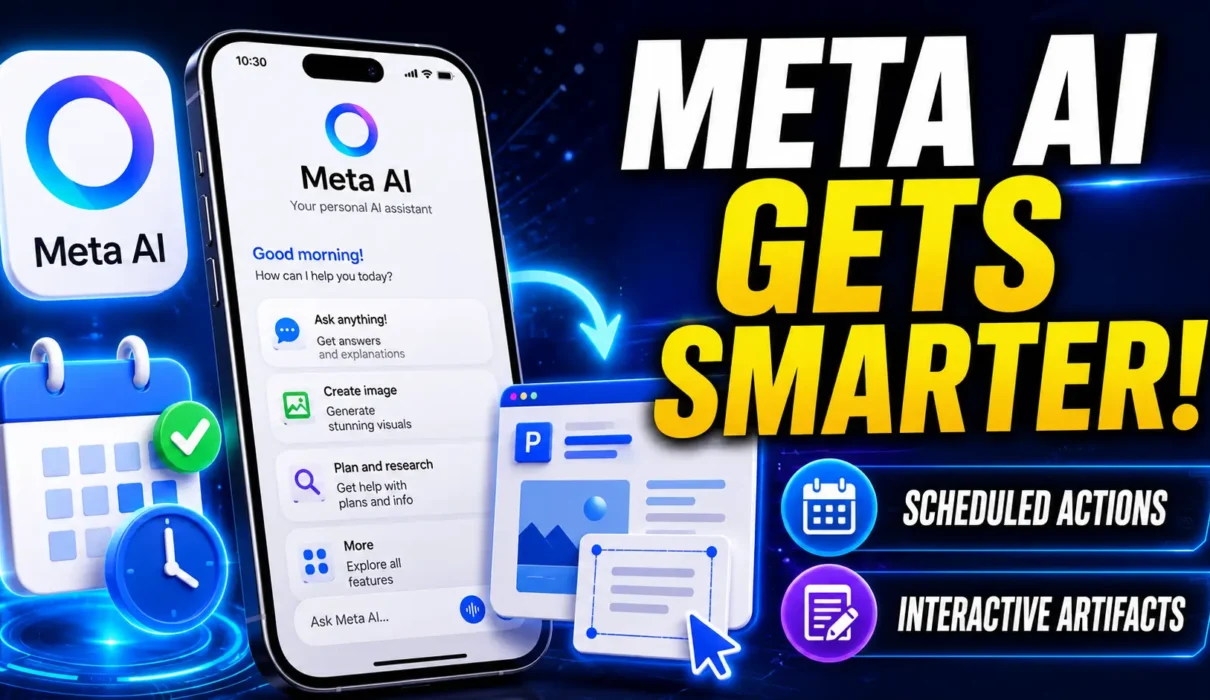
By Meta just gave its AI app two upgrades that actually matter: Scheduled Actions, which let the assistant repeat a task on its own without you asking again. Meta AI mobile app 2nd upgrade is Interactive Artifacts, which let you keep tweaking an AI-generated project while it’s still being built instead of starting over every time you want a change.
Both run on Muse Spark 1.1, Meta’s newest reasoning model, and together they push Meta AI from “answers your questions” toward “keeps working after you close the app.”
Who actually gets this, and when
Here’s the part most coverage glosses over: the rollout is US-first for now, with more countries expected in the coming weeks. It’s live in the Meta AI app on iOS and Android, plus meta.ai, and it’s free. If you were hoping to use this inside WhatsApp specifically, hold off-Meta says that’s coming soon but isn’t live yet. Under the hood, it’s running Muse Spark 1.1 in “Thinking” mode, with a context window of up to 1 million tokens, which is a big part of how the assistant actually remembers what you asked it to do last week.
Scheduled Actions: set it once, it just keeps going
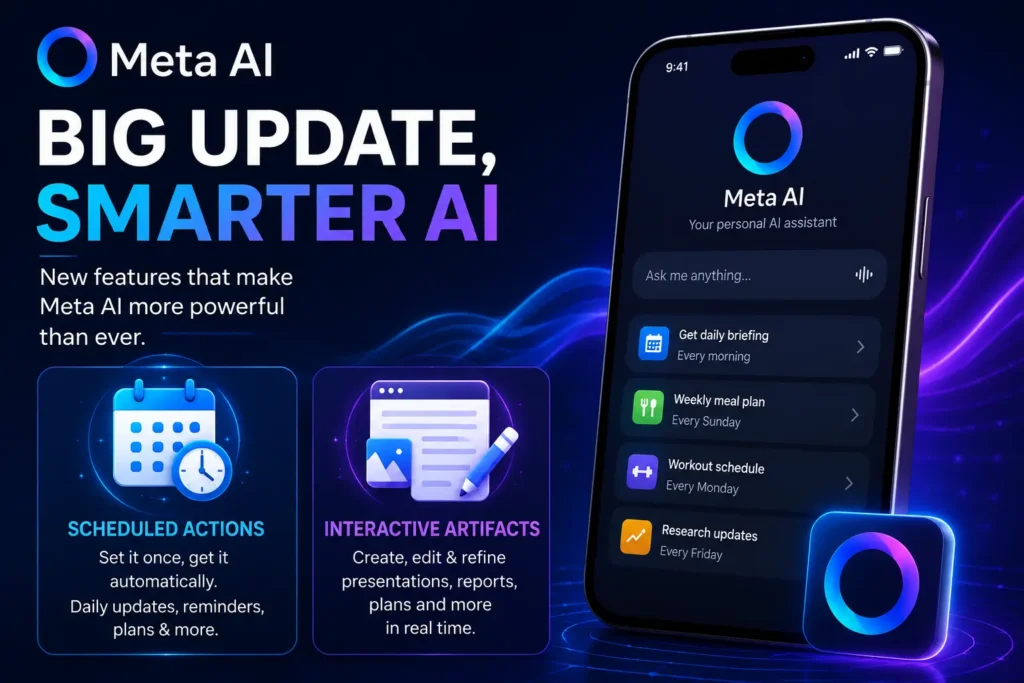
Before this, getting the same kind of answer from Meta AI every week meant typing the same prompt every week-a new meal plan, a new morning briefing, a new progress check, over and over. Scheduled Actions kills that repetition. You set up the request once, and Meta AI keeps delivering it on whatever schedule you pick, daily, weekly, or custom, without you having to remind it.
Meta’s own demo examples give a good sense of what this looks like in practice: a half-marathon training plan that regenerates your weekly workout schedule based on your actual calendar, or a home-renovation assistant that quietly keeps scanning Facebook Marketplace for furniture that fits your style and budget and resurfaces new matches as they show up.
Interactive Artifacts: editing while it’s still building
Most AI tools hand you a finished response, and if you want a real change, you’re regenerating the whole thing from scratch. Interactive Artifacts work differently, the workspace stays open and editable while Meta AI is still building it, so you can throw in a new instruction mid-generation instead of starting over.
Meta says this covers presentations, long reports, planning docs, study guides, mood boards, travel itineraries, and similar multi-step projects, and everything gets saved automatically so you can come back and keep refining it later.
What Muse Spark 1.1 actually brings to the table
The model behind all of this is built for planning and follow-through rather than one-off conversation, and two specs explain most of why it feels different. The 1-million-token context window means it can hold a huge amount of prior conversation and task history, which is a big part of how it “remembers” a recurring request instead of treating every prompt like a fresh start. And Meta says it’s built to coordinate across connected apps like email and calendar, not just generate text in a box. Meta’s also opened a public preview of the Meta Model API so that developers can build directly on Muse Spark 1.1 themselves.
How it stacks up against ChatGPT and Gemini
Meta isn’t the only one chasing this. ChatGPT has its own recurring-task feature, and both Google and Anthropic have shipped agent-style tools that carry work across multiple steps too. What actually sets Meta AI apart isn’t the model itself so much as its direct plug-in to Meta’s own ecosystem-Facebook Marketplace already, WhatsApp soon-access the other players don’t have.
Quick answers
Is it free? Yes, both features are free in the Meta AI app and on meta.ai.
Which countries have it? US first, with more countries coming over the next few weeks and no full list published yet.
Does it work in WhatsApp? Not yet. It’s confirmed to be coming, just not live at the time of writing.
What makes Muse Spark 1.1 different from earlier Meta AI models? It’s built for planning and multi-step follow-through, with a 1-million-token context window and app coordination, where earlier versions were mostly single-turn conversation, image generation, and search.
How does it compare to ChatGPT or Gemini? The core idea, an assistant that keeps working without repeated prompting, isn’t unique to Meta. What is unique is the direct tie-in to Meta’s own products.
Potential Impact
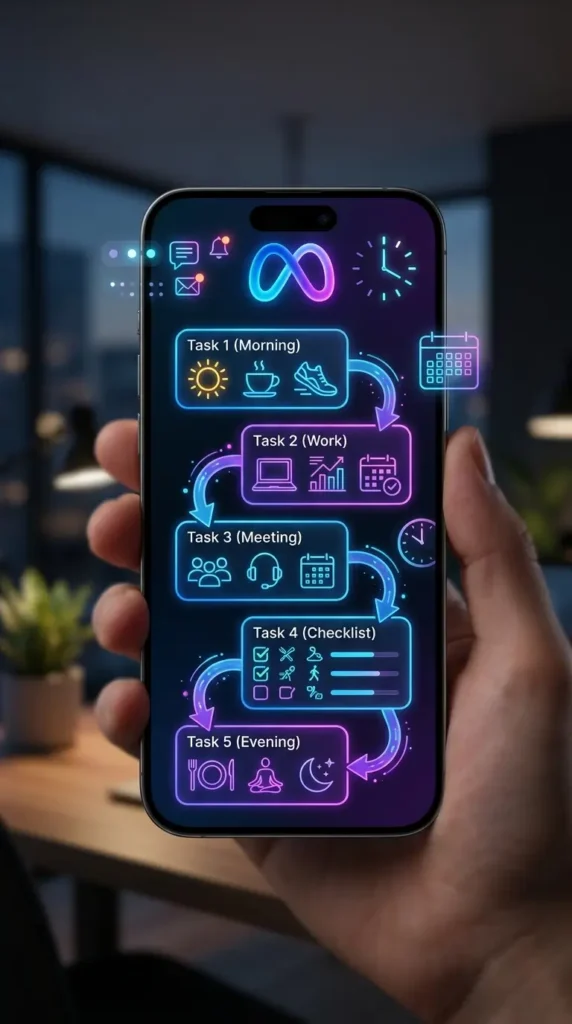
The introduction of Scheduled Actions and Interactive Artifacts could significantly change how consumers use artificial intelligence in everyday life.
For me, To be honest, this is a very happy thing for me because I use AI in my daily life, whether it is for creating photos or writing prompts.
For individual users, recurring automation may reduce repetitive work by allowing Meta AI to handle reminders, research, schedules, and routine planning without repeated instructions.
Students and professionals may benefit from Interactive Artifacts when preparing presentations, research papers, travel plans, project proposals, and collaborative documents that often require multiple revisions.
Businesses could also see productivity gains as AI assistants become increasingly capable of supporting administrative tasks and ongoing workflows.